Advertisements
Advertisements
प्रश्न
What are the conditions for obtaining a good interference pattern? Give reasons.
What is the essential condition for obtaining sustained interference?
Advertisements
उत्तर १
The conditions necessary for obtaining a well-defined and steady interference pattern are:
- The two sources of light should be coherent: This is the essential condition for getting a sustained interference pattern. As we have seen, the waves emitted by two coherent sources are always in phase or have a constant phase difference between them at all times. If the phases and phase differences vary with time, the positions of maxima and minima will also change with time, and the interference pattern will not be steady. For this reason, it is preferred that the two secondary sources used in the interference experiment are derived from a single original source.
- The light should be monochromatic: As can be seen from the condition of bright and dark fringes, the position of these fringes as well as the width of the fringes depend on the wavelength of light and the fringes of different colours are not coincident. The resultant pattern contains coloured, overlapping bands.
- The two interfering waves must have the same amplitude: Only if the amplitudes are equal, the intensity of dark fringes (destructive interference) is zero and the contrast between bright and dark fringes will be maximum.
- The two light sources should be narrow: If the slits are broad, the distances from different points along the slit to a given point on the screen are significantly different and therefore, the waves coming through the same slit will interfere among themselves, causing blurring of the interference pattern.
- The interfering light waves should be in the same state of polarization: Otherwise, the points where the waves meet in the opposite phase will not be completely dark and the interference pattern will not be distinct.
- The two waves should be in the same state of polarization: This is necessary only if polarized light is used for the experiment.
उत्तर २
- The two light sources must be coherent, which implies that the light waves they emit must have a constant phase difference or be the same phase.
- The two series must emit light of the same wavelength, but the amplitude between them should differ as little as possible.
संबंधित प्रश्न
State any one difference between interference of light and diffraction of light
A long narrow horizontal slit is paced 1 mm above a horizontal plane mirror. The interference between the light coming directly from the slit and that after reflection is seen on a screen 1.0 m away from the slit. If the mirror reflects only 64% of the light energy falling on it, what will be the ratio of the maximum to the minimum intensity in the interference pattern observed on the screen?
The intensity at the central maximum (O) in a Young’s double slit experimental set-up shown in the figure is IO. If the distance OP equals one-third of the fringe width of the pattern, show that the intensity at point P, would equal `(I_0)/4`.
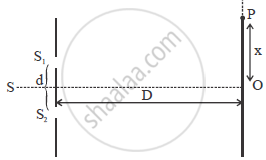
In Young’s double slit experiment, the slits are separated by 0.5 mm and screen is placed 1.0 m away from the slit. It is found that the 5th bright fringe is at a distance of 4.13 mm from the 2nd dark fringe. Find the wavelength of light used.
Answer in brief:
Explain what is the optical path length. How is it different from actual path length?
A double-slit arrangement produces interference fringes for sodium light (λ = 589 nm) that are 0.20° apart. What is the angular fringe separation if the entire arrangement is immersed in water (n = 1.33)?
Describe geometry of the Young’s double slit experiment with the help of a ray diagram. What is fringe width? Obtain an expression of it. Write the conditions for constructive as well as destructive interference.
What are coherent sources of light?
Explain constructive and destructive interference with the help of a diagram?
Obtain the equation for resultant intensity due to interference of light.
In Young’s double-slit experiment, 62 fringes are seen in the visible region for sodium light of wavelength 5893 Å. If violet light of wavelength 4359 Å is used in place of sodium light, then what is the number of fringes seen?
The interference pattern is obtained with two coherent light sources of intensity ratio n. In the interference pattern, the ratio `("I"_"max" - "I"_"min")/("I"_"max" + "I"_"min")` will be ______
On a rainy day, a small oil film on water shows brilliant colours. This is due to ____________.
In a Young's double-slit experiment, the intensity at a point where the path difference is `lambda/3` (`lambda` being the wavelength of the light used) is I. If I0 denotes the maximum intensity, then `"I"/"I"_0` is equal to ______.
In a Young's experiment, two coherent sources are placed 0.60 mm apart and the fringes are observed one metre away. If it produces the second dark fringe at a distance of 1 mm from the central fringe, the wavelength of monochromatic light used would be ____________.
In Young's double slit experiment, the two slits act as coherent sources of equal amplitude A and wavelength `lambda`. In another experiment with the same set up the two slits are of equal amplitude A and wavelength `lambda`. but are incoherent. The ratio of the intensity of light at the mid-point of the screen in the first case to that in the second case is ____________.
Two sources of light 0.5 mm apart are placed at a distance of 2.4 m and wavelength of light is 5000 Å. The phase difference between the two light waves interfering on the screen at a point at a distance 3 mm from central bright band is ____________.
Two coherent light sources of intensity ratio 'n' are employed in an interference experiment. The ratio of the intensities of the maxima and minima in the interference pattern is (I1 > I2).
Two identical light sources s1 and s2 emit light of same wavelength `lambda`. These light rays will exhibit interference if their ______.
`phi "and" phi_2 (phi_1 > phi_2)` are the work functions of metals A and B. When light of same wavelength is incident on A and B, the fastest emitted electrons from A are ____________ those emitted from B.
Waves from two coherent sources of light having an intensity ratio I1 : I2 equal to 'x' interfere. Then in the interference pattern obtained on the screen, the value of (Imax - Imin)/(Imax + Imin) is ______
In Young's double-slit experiment, if the two sources of light are very wide, then ______.
A beam of electrons is used in Young's double-slit experiment. If the speed of electrons is increased then the fringe width will ______.
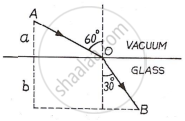
A ray of light AO in a vacuum is incident on a glass slab at an angle of 60° and refracted at an angle of 30° along OB as shown in the figure. The optical path length of the light ray from A to B is ______.
In biprism experiment the maximum intensity is ‘I0’. If the path difference between the two interfering waves is ‘λ/4’ then intensity at the point on the screen is ______.
`[sin 45^circ = cos 45^circ = 1/sqrt 2]`
