Advertisements
Advertisements
प्रश्न
In biprism experiment, the distance of 20th bright band from the central bright band is 1.2 cm. Without changing the experimental set-up, the distance of 30th bright band from the central bright band will be ______.
विकल्प
0.6 cm
0.8 cm
1.2 cm
1.8 cm
Advertisements
उत्तर
In biprism experiment, the distance of 20th bright band from the central bright band is 1.2 cm. Without changing the experimental set-up, the distance of 30 bright band from the central bright band will be 1.8 cm.
Explanation:
Given:
X20 = 1.2 cm, X30 = ?
For nth bright band `x_n = (Dnlambda)/d`
For 20th bright band `x_20 = 20(Dnlambda)/d` ...(1)
For 30th bright band `x_30 = 30(Dnlambda)/d` ...(2)
Dividing equation (2) by equation (1)
`x_30/x_20 = 30/20`
∴ `x_30 = x_20 xx 3/2`
= `1.2 xx 3/2`
= 1.8 cm
APPEARS IN
संबंधित प्रश्न
State any one difference between interference of light and diffraction of light
A narrow slit S transmitting light of wavelength λ is placed a distance d above a large plane mirror, as shown in the following figure. The light coming directly from the slit and that coming after the reflection interfere at a screen ∑ placed at a distance D from the slit. (a) What will be the intensity at a point just above the mirror, i.e. just above O? (b) At what distance from O does the first maximum occur?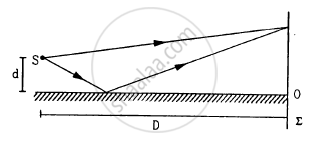
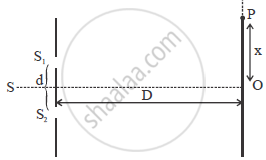
The intensity at the central maximum (O) in a Young’s double slit experimental set-up shown in the figure is IO. If the distance OP equals one-third of the fringe width of the pattern, show that the intensity at point P, would equal `(I_0)/4`.
Why are multiple colours observed over a thin film of oil floating on water? Explain with the help of a diagram.
Describe Young's double-slit interference experiment and derive conditions for occurrence of dark and bright fringes on the screen. Define fringe width and derive a formula for it.
Describe geometry of the Young’s double slit experiment with the help of a ray diagram. What is fringe width? Obtain an expression of it. Write the conditions for constructive as well as destructive interference.
How do source and images behave as coherent sources?
What is a bandwidth of interference pattern?
Obtain the equation for resultant intensity due to interference of light.
The interference pattern is obtained with two coherent light sources of intensity ratio n. In the interference pattern, the ratio `("I"_"max" - "I"_"min")/("I"_"max" + "I"_"min")` will be ______
In Young's double slit experiment green light is incident on the two slits. The interference pattern is observed on a screen. Which one of the following changes would cause the observed fringes to be more closely spaced?
A thin transparent sheet is placed in front of a slit in Young's double slit experiment. The fringe width will ____________.
The distance between the first and ninth bright fringes formed in a biprism experiment is ______.
(`lambda` = 6000 A, D = 1.0 m, d = 1.2 mm)
Two identical light waves having phase difference 'Φ' propagate in same direction. When they superpose, the intensity of the resultant wave is proportional to ______.
A wire of length 'L' and area of cross-section · A' is made of material of Young's modulus 'Y'. It is stretched by an amount 'x'. The work done in stretching the wire is ______.
In a double slit experiment, the two slits are 2 mm apart and the screen is placed 1 m away. A monochromatic light of wavelength 500 nm is used. What will be the width of each slit for obtaining ten maxima of double slit within the central maxima of single slit pattern?
In a biprism experiment, D = 1 m, `lambda` = 6000 Å. When a convex lens is interposed between the biprism ru1d the eyepiece, then the distance between the images of the slits given by the Jens at two positions are 1.5 mm and 6.0 mm. The fringe width will be ______.
In Young's double slit experiment with a source of light of wavelength 5860 Å, the first maxima will occur when ____________.
In Young's double slit experiment, the two slits act as coherent sources of equal amplitude A and wavelength `lambda`. In another experiment with the same set up the two slits are of equal amplitude A and wavelength `lambda`. but are incoherent. The ratio of the intensity of light at the mid-point of the screen in the first case to that in the second case is ____________.
The phenomenon of interference is based on ______.
Two coherent light sources of intensity ratio 'n' are employed in an interference experiment. The ratio of the intensities of the maxima and minima in the interference pattern is (I1 > I2).
In biprism experiment, the 4th dark band is formed opposite to one of the slits. The wavelength of light used is ______.
In the Young's double slit experiment, if the phase difference between the two waves interfering at a point is `phi`, the intensity at that point is proportional to ____________.
Two identical light sources s1 and s2 emit light of same wavelength `lambda`. These light rays will exhibit interference if their ______.
`phi "and" phi_2 (phi_1 > phi_2)` are the work functions of metals A and B. When light of same wavelength is incident on A and B, the fastest emitted electrons from A are ____________ those emitted from B.
The graph shows the variation of fringe width (β) versus distance of the screen from the plane of the slits (D) in Young's double-slit experiment Keeping other parameters the same. The wavelength of light used can be calculated as d = distance between the slits ______

In Young's double slit experiment, for wavelength λ1 the nth bright fringe is obtained at a point P on the screen. Keeping the same setting, source of light is replaced by wavelength λ2 and now (n + 1)th bright fringe is obtained at the same point P on the screen. The value of n is ______.
Two waves with same amplitude and frequency superpose at a point. The ratio of resultant intensities when they arrive in phase to that when they arrive 90° out of phase is ______.
`[cos pi/2=0]`
If we have two coherent sources S1 and S2 vibrating in phase, then for an arbitrary point P constructive interference is observed whenever the path difference is ______.
How will the interference pattern of Young's double slit change if one of the two slits is covered by a paper which transmits only half of the light intensity?
