Advertisements
Advertisements
प्रश्न
In a Young’s double-slit experiment, the slit separation is doubled. To maintain the same fringe spacing on the screen, the screen-to-slit distance D must be changed to ______.
विकल्प
2D
`"D"/2`
`sqrt2"D"`
`"D"/sqrt2`
Advertisements
उत्तर
In a Young’s double-slit experiment, the slit separation is doubled. To maintain the same fringe spacing on the screen, the screen-to-slit distance D must be changed to 2D.
APPEARS IN
संबंधित प्रश्न
A narrow slit S transmitting light of wavelength λ is placed a distance d above a large plane mirror, as shown in the following figure. The light coming directly from the slit and that coming after the reflection interfere at a screen ∑ placed at a distance D from the slit. (a) What will be the intensity at a point just above the mirror, i.e. just above O? (b) At what distance from O does the first maximum occur?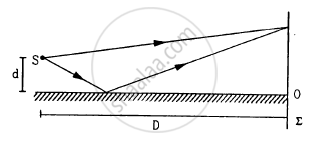
A long narrow horizontal slit is paced 1 mm above a horizontal plane mirror. The interference between the light coming directly from the slit and that after reflection is seen on a screen 1.0 m away from the slit. Find the fringe-width if the light used has a wavelength of 700 nm.
Why are multiple colours observed over a thin film of oil floating on water? Explain with the help of a diagram.
What is meant by coherent sources?
Describe Young's double-slit interference experiment and derive conditions for occurrence of dark and bright fringes on the screen. Define fringe width and derive a formula for it.
What are the conditions for obtaining a good interference pattern? Give reasons.
What are the two methods for obtaining coherent sources in the laboratory?
What are coherent sources of light?
In Young's double slit experiment green light is incident on the two slits. The interference pattern is observed on a screen. Which one of the following changes would cause the observed fringes to be more closely spaced?
In Young's double-slit experiment, in an interference pattern, a second minimum is observed exactly in front of one slit. The distance between the two coherent sources is 'd' and the distance between source and screen is 'D'. The wavelength of the light source used is ______
If the monochromatic source in Young's double slit experiment is white light, then ____________.
The distance between the first and ninth bright fringes formed in a biprism experiment is ______.
(`lambda` = 6000 A, D = 1.0 m, d = 1.2 mm)
In the biprism experiment, the fringe width is 0.4 mm. What is the distance between the 4th dark band and the 6th bright band on the same side?
Waves from two coherent sources of light having an intensity ratio I1 : I2 equal to 'x' interfere. Then in the interference pattern obtained on the screen, the value of (Imax - Imin)/(Imax + Imin) is ______
A beam of electrons is used in Young's double-slit experiment. If the speed of electrons is increased then the fringe width will ______.
White light is passed through a double slit and interference is observed on a screen 1.5 m away. The separation between the slits is 0.3 mm. The first violet and red fringes are formed 2.0 mm and 3.5 mm away from the central white fringes. The difference in wavelengths of red and violet light is ______ nm.
The interference pattern is obtained with two coherent light sources of intensity ratio 4 : 1. And the ratio `("I"_"max" - "I"_"min")/("I"_"max" + "I"_"min")` is `5/x`. Then the value of x will be equal to ______.
Interference fringes are produced on a screen by using two light sources of intensities I and 9I. The phase difference between the beams is `pi/2` at point P and π at point Q on the screen. The difference between the resultant intensities at point P and Q is ______.
With a neat labelled ray diagram explain the use of Fresnel's biprism to obtain two coherent sources.
In biprism experiment, the distance of 20th bright band from the central bright band is 1.2 cm. Without changing the experimental set-up, the distance of 30th bright band from the central bright band will be ______.
