Advertisements
Advertisements
प्रश्न
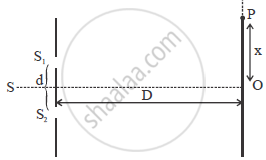
One of Young’s double slits is covered with a glass plate as shown in figure. The position of central maximum will,

विकल्प
get shifted downwards
get shifted upwards
will remain the same
data insufficient to conclude
Advertisements
उत्तर
get shifted upwards
APPEARS IN
संबंधित प्रश्न
Write the important characteristic features by which the interference can be distinguished from the observed diffraction pattern.
The intensity at the central maximum (O) in a Young’s double slit experimental set-up shown in the figure is IO. If the distance OP equals one-third of the fringe width of the pattern, show that the intensity at point P, would equal `(I_0)/4`.
What is meant by coherent sources?
In a Young’s double-slit experiment, the slit separation is doubled. To maintain the same fringe spacing on the screen, the screen-to-slit distance D must be changed to ______.
What is phase of a wave?
Discuss the interference in thin films and obtain the equations for constructive and destructive interference for transmitted and reflected light.
In Young's double-slit experiment, if the width of the 2nd bright fringe is 4 x 10⁻² cm, then the width of the 4th bright fringe will be ______ cm.
In Young's double slit experiment green light is incident on the two slits. The interference pattern is observed on a screen. Which one of the following changes would cause the observed fringes to be more closely spaced?
Band width for red light of wavelength 6600 Å is 0.42 mm. If red Light is replaced by blue light of wavelength 4400 Å, then the change m bandwidth will be ____________.
A wire of length 'L' and area of cross-section · A' is made of material of Young's modulus 'Y'. It is stretched by an amount 'x'. The work done in stretching the wire is ______.
In a double slit experiment, the two slits are 2 mm apart and the screen is placed 1 m away. A monochromatic light of wavelength 500 nm is used. What will be the width of each slit for obtaining ten maxima of double slit within the central maxima of single slit pattern?
In Young's double slit experiment the source is white light. One slit is covered with red filter and the other with blue filter. There shall be ____________.
In Young's double-slit experiment, if the two sources of light are very wide, then ______.
In Young's double-slit experiment, the distance between the slits is 3 mm and the slits are 2 m away from the screen. Two interference patterns can be obtained on the screen due to light of wavelength 480 nm and 600 run respectively. The separation on the screen between the 5th order bright fringes on the two interference patterns is ______
In an interference experiment, the intensity at a point is `(1/4)^"th"` of the maximum intensity. The angular position of this point is at ____________.
(cos 60° = 0.5, `lambda` = wavelength of light, d = slit width)
How will the interference pattern of Young's double slit change if one of the two slits is covered by a paper which transmits only half of the light intensity?
Show graphically the intensity distribution in a single slit diffraction pattern.
White light is passed through a double slit and interference is observed on a screen 1.5 m away. The separation between the slits is 0.3 mm. The first violet and red fringes are formed 2.0 mm and 3.5 mm away from the central white fringes. The difference in wavelengths of red and violet light is ______ nm.
Two coherent sources P and Q produce interference at point A on the screen where there is a dark band which is formed between 4th bright band and 5th bright band. Wavelength of light used is 6000 Å. The path difference between PA and QA is ______.
In biprism experiment the maximum intensity is ‘I0’. If the path difference between the two interfering waves is ‘λ/4’ then intensity at the point on the screen is ______.
`[sin 45^circ = cos 45^circ = 1/sqrt 2]`
