Advertisements
Advertisements
प्रश्न
What is phase of a wave?
Advertisements
उत्तर
Phase is a particular point in time on the cycle of a waveform, measured as an angle in degrees.
APPEARS IN
संबंधित प्रश्न
Why are multiple colours observed over a thin film of oil floating on water? Explain with the help of a diagram.
Obtain the equation for resultant intensity due to interference of light.
Light of wavelength 600 nm that falls on a pair of slits producing interference pattern on a screen in which the bright fringes are separated by 7.2 mm. What must be the wavelength of another light which produces bright fringes separated by 8.1 mm with the same apparatus?
A graph is plotted between the fringe-width Z and the distance D between the slit and eye-piece, keeping other adjustment same. The correct graph is
A.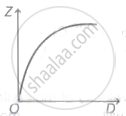 |
B.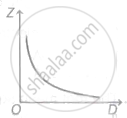 |
C.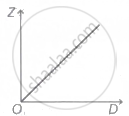 |
D.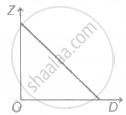 |
On a rainy day, a small oil film on water shows brilliant colours. This is due to ____________.
The distance between the first and ninth bright fringes formed in a biprism experiment is ______.
(`lambda` = 6000 A, D = 1.0 m, d = 1.2 mm)
In a double slit experiment, the two slits are 2 mm apart and the screen is placed 1 m away. A monochromatic light of wavelength 500 nm is used. What will be the width of each slit for obtaining ten maxima of double slit within the central maxima of single slit pattern?
In Young's double slit experiment fifth dark fringe is formed opposite to one of the slits. If D is the distance between the slits and the screen and d is the separation between the slits, then the wavelength of light used is ______.
In interference experiment, intensity at a point is `(1/4)^"th"` of the maximum intensity. The angular position of this point is at (sin30° = cos60° = 0.5, `lambda` = wavelength of light, d = slit width) ____________.
In a biprism experiment, red light of wavelength 6500 Å was used. It was then replaced by green light of wavelength 5200 Å. The value of n for which (n + 1)th green bright band would coincide with nth red bright band for the same setting is ______.
`phi "and" phi_2 (phi_1 > phi_2)` are the work functions of metals A and B. When light of same wavelength is incident on A and B, the fastest emitted electrons from A are ____________ those emitted from B.
In a biprism experiment, the slit separation is 1 mm. Using monochromatic light of wavelength 5000 Å, an interference pattern is obtained on the screen. Where should the screen be moved? so that the change in fringe width is 12.5 x 10⁵ m?
Waves from two coherent sources of light having an intensity ratio I1 : I2 equal to 'x' interfere. Then in the interference pattern obtained on the screen, the value of (Imax - Imin)/(Imax + Imin) is ______
Two coherent sources of intensities I1 and I2 produce an interference pattern on the screen. The maximum intensity in the interference pattern is ______
A beam of electrons is used in Young's double-slit experiment. If the speed of electrons is increased then the fringe width will ______.
The path difference between two interference light waves meeting at a point on the screen is `(87/2)lambda`. The band obtained at that point is ______.
With a neat labelled ray diagram explain the use of Fresnel's biprism to obtain two coherent sources.
In biprism experiment the maximum intensity is ‘I0’. If the path difference between the two interfering waves is ‘λ/4’ then intensity at the point on the screen is ______.
`[sin 45^circ = cos 45^circ = 1/sqrt 2]`
In a biprism experiment, fifth dark fringe is obtained at a point. A thin transparent film of refractive index ‘μ’ is placed in one of the interfering paths. Now 7th bright fringe is obtained at the same point. If ‘A’ is the wavelength of light used, the thickness of film is equal to ______.
