Advertisements
Advertisements
प्रश्न
How do source and images behave as coherent sources?
Advertisements
उत्तर
- In the source and images method, a source and its image will act as a set of coherent sources, because the source and its image will have waves in-phase or constant phase difference as shown in the following figure.
- The Instrument, Fresnel’s biprism uses two virtual sources as two coherent sources and the instrument, Lloyd’s mirror uses a source and its virtual image as two coherent sources.


Using virtual and real images of a source as coherent sources
APPEARS IN
संबंधित प्रश्न
Laser light of wavelength 630 nm is incident on a pair of slits which are separated by 1.8 mm. If the screen is kept 80 cm away from the two slits, calculate:
1) fringe separation i.e. fringe width.
2) distance of 10th bright fringe from the centre of the interference pattern
The intensity at the central maximum (O) in a Young’s double slit experimental set-up shown in the figure is IO. If the distance OP equals one-third of the fringe width of the pattern, show that the intensity at point P, would equal `(I_0)/4`.
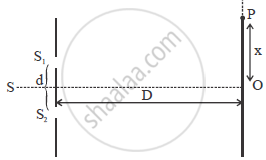
In Young’s double slit experiment, the slits are separated by 0.5 mm and screen is placed 1.0 m away from the slit. It is found that the 5th bright fringe is at a distance of 4.13 mm from the 2nd dark fringe. Find the wavelength of light used.
Answer in brief:
In Young's double-slit experiment what will we observe on the screen when white light is incident on the slits but one slit is covered with a red filter and the other with a violet filter? Give reasons for your answer.
Obtain the relation between phase difference and path difference.
If the monochromatic source in Young's double slit experiment is white light, then ____________.
Two identical light waves having phase difference 'Φ' propagate in same direction. When they superpose, the intensity of the resultant wave is proportional to ______.
A thin mica sheet of thickness 4 x 10⁻⁶ m and refractive index 1.5 is introduced in the path of the first wave. The wavelength of the wave used is 5000 A. The central bright maximum will shift ______.
In Young's double-slit experiment, an interference pattern is obtained on a screen by a light of wavelength 4000 Å, coming from the coherent sources S1 and S2 At certain point P on the screen, third dark fringe is formed. Then the path difference S1P - S2P in microns is ______.
In Young's double slit experiment with a source of light of wavelength 5860 Å, the first maxima will occur when ____________.
In Young's double slit experiment, the two slits act as coherent sources of equal amplitude A and wavelength `lambda`. In another experiment with the same set up the two slits are of equal amplitude A and wavelength `lambda`. but are incoherent. The ratio of the intensity of light at the mid-point of the screen in the first case to that in the second case is ____________.
In Young's double slit experiment the source is white light. One slit is covered with red filter and the other with blue filter. There shall be ____________.
Two coherent light sources of intensity ratio 'n' are employed in an interference experiment. The ratio of the intensities of the maxima and minima in the interference pattern is (I1 > I2).
In the Young's double slit experiment, if the phase difference between the two waves interfering at a point is `phi`, the intensity at that point is proportional to ____________.
In the biprism experiment, the fringe width is 0.4 mm. What is the distance between the 4th dark band and the 6th bright band on the same side?
Waves from two coherent sources of light having an intensity ratio I1 : I2 equal to 'x' interfere. Then in the interference pattern obtained on the screen, the value of (Imax - Imin)/(Imax + Imin) is ______
In the biprism experiment, a source of monochromatic light is used for a certain distance between slit and eyepiece. When the distance between two virtual sources is changed from dA to dB, then the fringe width is changed from ZA to ZB. The ratio ZA to ZB is ______
In Young's double slit experiment, for wavelength λ1 the nth bright fringe is obtained at a point P on the screen. Keeping the same setting, source of light is replaced by wavelength λ2 and now (n + 1)th bright fringe is obtained at the same point P on the screen. The value of n is ______.
A beam of electrons is used in Young's double-slit experiment. If the speed of electrons is increased then the fringe width will ______.
With a neat labelled ray diagram explain the use of Fresnel's biprism to obtain two coherent sources.
