Advertisements
Advertisements
Question
Explain constructive and destructive interference with the help of a diagram?
Advertisements
Solution
Constructive and destructive interference:
- Points, where the crest of one wave coincides with the crest of another wave and where the trough of one wave coincides with the trough of another wave, are points with the maximum displacement. At these points, displacement is twice that for each wave. These are points of constructive interference.
- Points, where the crest of one wave is coincident with the trough of another, are points with zero displacements. These are points of destructive interference.

Interference for waves
RELATED QUESTIONS
Write the necessary conditions to obtain sustained interference fringes.
Laser light of wavelength 630 nm is incident on a pair of slits which are separated by 1.8 mm. If the screen is kept 80 cm away from the two slits, calculate:
1) fringe separation i.e. fringe width.
2) distance of 10th bright fringe from the centre of the interference pattern
A narrow slit S transmitting light of wavelength λ is placed a distance d above a large plane mirror, as shown in the following figure. The light coming directly from the slit and that coming after the reflection interfere at a screen ∑ placed at a distance D from the slit. (a) What will be the intensity at a point just above the mirror, i.e. just above O? (b) At what distance from O does the first maximum occur?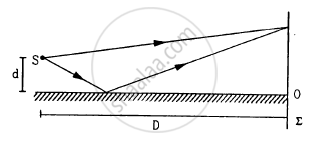
Answer in brief:
In Young's double-slit experiment what will we observe on the screen when white light is incident on the slits but one slit is covered with a red filter and the other with a violet filter? Give reasons for your answer.
What are the conditions for obtaining a good interference pattern? Give reasons.
What is phase of a wave?
How do source and images behave as coherent sources?
What is a bandwidth of interference pattern?
In Young's double-slit experiment, if the width of the 2nd bright fringe is 4 x 10⁻² cm, then the width of the 4th bright fringe will be ______ cm.
A graph is plotted between the fringe-width Z and the distance D between the slit and eye-piece, keeping other adjustment same. The correct graph is
A.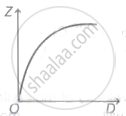 |
B.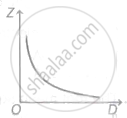 |
C.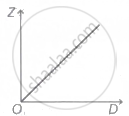 |
D. |
A thin transparent sheet is placed in front of a slit in Young's double slit experiment. The fringe width will ____________.
The distance between the first and ninth bright fringes formed in a biprism experiment is ______.
(`lambda` = 6000 A, D = 1.0 m, d = 1.2 mm)
Two identical light waves having phase difference 'Φ' propagate in same direction. When they superpose, the intensity of the resultant wave is proportional to ______.
In Young's double-slit experiment, an interference pattern is obtained on a screen by a light of wavelength 4000 Å, coming from the coherent sources S1 and S2 At certain point P on the screen, third dark fringe is formed. Then the path difference S1P - S2P in microns is ______.
In Young's double slit experiment fifth dark fringe is formed opposite to one of the slits. If D is the distance between the slits and the screen and d is the separation between the slits, then the wavelength of light used is ______.
Two coherent light sources of intensity ratio 'n' are employed in an interference experiment. The ratio of the intensities of the maxima and minima in the interference pattern is (I1 > I2).
If the two slits in Young's double slit experiment have width ratio 9 : 1, the ratio of maximum to minimum intensity in the interference pattern is ______.
In the Young's double slit experiment, if the phase difference between the two waves interfering at a point is `phi`, the intensity at that point is proportional to ____________.
In the biprism experiment, the fringe width is 0.4 mm. What is the distance between the 4th dark band and the 6th bright band on the same side?
Waves from two coherent sources of light having an intensity ratio I1 : I2 equal to 'x' interfere. Then in the interference pattern obtained on the screen, the value of (Imax - Imin)/(Imax + Imin) is ______
Young's double slit experiment is performed in water, instead of air, then fringe width ______.
A double slit experiment is immersed in water of refractive index 1.33. The slit separation is 1 mm, distance between slit and screen is 1.33 m. The slits are illuminated by a light of wavelength 6300 Å. The fringe width is ______.
What is meant by Constructive interference?
Show graphically the intensity distribution in a single slit diffraction pattern.
Interference fringes are produced on a screen by using two light sources of intensities I and 9I. The phase difference between the beams is `pi/2` at point P and π at point Q on the screen. The difference between the resultant intensities at point P and Q is ______.
In biprism experiment, the 3rd dark band is formed opposite to one of the slits. The wavelength of light used is ______.
(D = distance between source and screen, d = distance between the two narrow slits)
