Advertisements
Advertisements
Question
Obtain the equation for resultant intensity due to interference of light.
Advertisements
Solution
- The phenomenon of addition or superposition of two light waves which produces increase in intensity at some points and a decrease in intensity at some other points is called interference of light.
- Let us consider two light waves from the two sources S1 and S2 meeting at a point P as shown
- The wave from S1 at an instant t and P is, y1 = a1 sin ωt
The wave from S2 an instant t at P is
y2 = a2 sin(ωt + Φ)
Superposition principle - The two waves have different amplitudes a1 and a2, same angular frequency ω’ and a phase difference of Φ between them. The resultant displacement will be given by.
y = y1 + y2 = a1 sin ωt + a1 sin2 (ωt + Φ) y = A sin (ωt + Φ)
Where, A = `sqrt("a"_1^2 + "a"_2^2 + 2"a"_1"a"_2 cos phi)` .....(1)
`theta = tan^-1 ("a"_2 sin phi)/("a"_1 + "a"_2 cos phi)` ......(2) - The resultant amplitude is maximum.
Amax = `sqrt(("a"_1 + "a"_2)^2)`;
when Φ = 0, ±2π, ± 4π …….(3) - The resultant amplitude is minimum.
Amin = `sqrt(("a"_1 - "a"_2)^2)`;
when Φ = 0, ±π, ± 3π ± 5π …..(4) - The intensity of light is proportional to the square of amplitude.
- I α A2 ……(5)
Now equation (1) becomes
I α I1 + I2 + 2`sqrt("I"_1"I"_2)` cos Φ .(6) - 9. If the phase difference, Φ = 0, ± 2π, ± 4π., it corresponds to the condition for maximum intensity of light called as constructive interference.
- The resultant maximum intensity is,
Imax α (a1 + a2)2 …….(7) - If the phase difference, Φ = + π, ± 3π, ± 5π …., it corresponds to the condition for the minimum intensity of light called destructive interference.
- The resultant minimum intensity is Imin α
(a1 – a2)2 α I1 + I2 – 2`sqrt("I"_1"I"_2)` ......(8)
As a special case, if a1 = a2 = a, then equation (1) becomes,
A = `sqrt(2"a"^2 + 2"a"^2 cos phi)`
= `sqrt(2"a"^2 (1 + cos phi))`
= `sqrt(2"a"^2 2cos^2 (phi//2))` -
A = 2 a cos(Φ/2) ….(9)
I α 4a2 cos2 (Φ/2) [∴ I α A2] ……(10)
I α 4 I0 cos2 (Φ/ 2) [ΦI0 α a2] …….(11)
IMax = 4I0 when, Φ = o, ± 2π, 4π …..(12)
Imin = 0 when, Φ = ± π, ± 3π, ± 5π …..(13)
Conclusion:
The phase difference between the two waves decides the intensity of light meet at a point.
APPEARS IN
RELATED QUESTIONS
Four light waves are represented by
(i) \[y = a_1 \sin \omega t\]
(ii) \[y = a_2 \sin \left( \omega t + \epsilon \right)\]
(iii) \[y = a_1 \sin 2\omega t\]
(iv) \[y = a_2 \sin 2\left( \omega t + \epsilon \right).\]
Interference fringes may be observed due to superposition of
(a) (i) and (ii)
(b) (i) and (iii)
(c) (ii) and (iv)
(d) (iii) and (iv)
In Young’s double slit experiment, the slits are separated by 0.5 mm and screen is placed 1.0 m away from the slit. It is found that the 5th bright fringe is at a distance of 4.13 mm from the 2nd dark fringe. Find the wavelength of light used.
What is meant by coherent sources?
The ratio of maximum and minimum intensities in an interference pattern is 36 : 1. What is the ratio of the amplitudes of the two interfering waves?
The interference pattern is obtained with two coherent light sources of intensity ratio n. In the interference pattern, the ratio `("I"_"max" - "I"_"min")/("I"_"max" + "I"_"min")` will be ______
In Young's double-slit experiment, if the width of the 2nd bright fringe is 4 x 10⁻² cm, then the width of the 4th bright fringe will be ______ cm.
A graph is plotted between the fringe-width Z and the distance D between the slit and eye-piece, keeping other adjustment same. The correct graph is
A.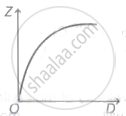 |
B.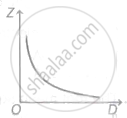 |
C.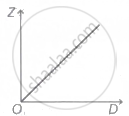 |
D.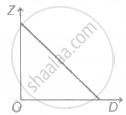 |
A wire of length 'L' and area of cross-section · A' is made of material of Young's modulus 'Y'. It is stretched by an amount 'x'. The work done in stretching the wire is ______.
In Young's double slit experiment with a source of light of wavelength 5860 Å, the first maxima will occur when ____________.
In interference experiment, intensity at a point is `(1/4)^"th"` of the maximum intensity. The angular position of this point is at (sin30° = cos60° = 0.5, `lambda` = wavelength of light, d = slit width) ____________.
In a biprism experiment, red light of wavelength 6500 Å was used. It was then replaced by green light of wavelength 5200 Å. The value of n for which (n + 1)th green bright band would coincide with nth red bright band for the same setting is ______.
`phi "and" phi_2 (phi_1 > phi_2)` are the work functions of metals A and B. When light of same wavelength is incident on A and B, the fastest emitted electrons from A are ____________ those emitted from B.
In a biprism experiment, the slit separation is 1 mm. Using monochromatic light of wavelength 5000 Å, an interference pattern is obtained on the screen. Where should the screen be moved? so that the change in fringe width is 12.5 x 10⁵ m?
Young's double slit experiment is performed in water, instead of air, then fringe width ______.
In an interference experiment, the intensity at a point is `(1/4)^"th"` of the maximum intensity. The angular position of this point is at ____________.
(cos 60° = 0.5, `lambda` = wavelength of light, d = slit width)
The interference pattern is obtained with two coherent light sources of intensity ratio 4 : 1. And the ratio `("I"_"max" - "I"_"min")/("I"_"max" + "I"_"min")` is `5/x`. Then the value of x will be equal to ______.
The path difference between two interference light waves meeting at a point on the screen is `(87/2)lambda`. The band obtained at that point is ______.
In a biprism experiment, fifth dark fringe is obtained at a point. A thin transparent film of refractive index ‘μ’ is placed in one of the interfering paths. Now 7th bright fringe is obtained at the same point. If ‘A’ is the wavelength of light used, the thickness of film is equal to ______.
