Advertisements
Advertisements
Question
Two ships leave a port at the same time. One goes 24 km/hr in the direction N 38° E and other travels 32 km/hr in the direction S 52° E. Find the distance between the ships at the end of 3 hrs.
Advertisements
Solution
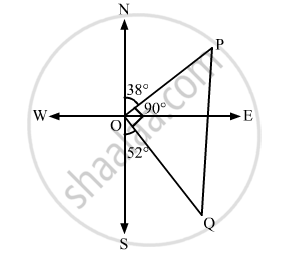
\[\text{ After three hours, let the ships be at P and Q respectively } . \]
\[\text{ Then }, \]
\[OP = 24 \times 3 = 72 km \text{ and } OQ = 32 \times 3 = 96 km\]
\[\text{ From figure, we have }\]
\[\angle POQ = 180° - \angle NOP - \angle SOQ\]
\[ = 180° - 38° - 52° \]
\[ = 90° \]
\[\text{ Now }, \]
\[\text{ Since OPQ is a right angled triangle }\]
\[ \therefore P Q^2 = O P^2 + O Q^2 \]
\[ \Rightarrow P Q^2 = {72}^2 + {96}^2 \]
\[ \Rightarrow P Q^2 = 5184 + 9216\]
\[ \Rightarrow P Q^2 = 14400\]
\[ \Rightarrow PQ = \sqrt{14400} = 120 km\]
\[\text{Hence, the distance between the ships after 3 hours is 120 km} .\]
RELATED QUESTIONS
If in ∆ABC, ∠A = 45°, ∠B = 60° and ∠C = 75°, find the ratio of its sides.
In ∆ABC, if a = 18, b = 24 and c = 30 and ∠c = 90°, find sin A, sin B and sin C.
In triangle ABC, prove the following:
In triangle ABC, prove the following:
In triangle ABC, prove the following:
\[\frac{a^2 - c^2}{b^2} = \frac{\sin \left( A - C \right)}{\sin \left( A + C \right)}\]
In triangle ABC, prove the following:
In triangle ABC, prove the following:
In triangle ABC, prove the following:
In triangle ABC, prove the following:
In triangle ABC, prove the following:
In triangle ABC, prove the following:
\[a \left( \cos B \cos C + \cos A \right) = b \left( \cos C \cos A + \cos B \right) = c \left( \cos A \cos B + \cos C \right)\]
The upper part of a tree broken by the wind makes an angle of 30° with the ground and the distance from the root to the point where the top of the tree touches the ground is 15 m. Using sine rule, find the height of the tree.
At the foot of a mountain, the elevation of it summit is 45°; after ascending 1000 m towards the mountain up a slope of 30° inclination, the elevation is found to be 60°. Find the height of the mountain.
A person observes the angle of elevation of the peak of a hill from a station to be α. He walks c metres along a slope inclined at an angle β and finds the angle of elevation of the peak of the hill to be ϒ. Show that the height of the peak above the ground is \[\frac{c \sin \alpha \sin \left( \gamma - \beta \right)}{\left( \sin \gamma - \alpha \right)}\]
If the sides a, b and c of ∆ABC are in H.P., prove that \[\sin^2 \frac{A}{2}, \sin^2 \frac{B}{2} \text{ and } \sin^2 \frac{C}{2}\]
In \[∆ ABC, if a = 5, b = 6 a\text{ and } C = 60°\] show that its area is \[\frac{15\sqrt{3}}{2} sq\].units.
In \[∆ ABC, if a = \sqrt{2}, b = \sqrt{3} \text{ and } c = \sqrt{5}\] show that its area is \[\frac{1}{2}\sqrt{6} sq .\] units.
In ∆ABC, prove the following: \[b \left( c \cos A - a \cos C \right) = c^2 - a^2\]
In ∆ABC, prove the following: \[c \left( a \cos B - b \cos A \right) = a^2 - b^2\]
In ∆ABC, prove the following:
\[2 \left( bc \cos A + ca \cos B + ab \cos C \right) = a^2 + b^2 + c^2\]
In ∆ABC, prove the following:
\[\left( c^2 - a^2 + b^2 \right) \tan A = \left( a^2 - b^2 + c^2 \right) \tan B = \left( b^2 - c^2 + a^2 \right) \tan C\]
In ∆ABC, prove the following:
\[\frac{c - b \cos A}{b - c \cos A} = \frac{\cos B}{\cos C}\]
In ∆ABC, prove the following:
\[\sin^3 A \cos \left( B - C \right) + \sin^3 B \cos \left( C - A \right) + \sin^3 C \cos \left( A - B \right) = 3 \sin A \sin B \sin C\]
In \[∆ ABC, if \angle B = 60°,\] prove that \[\left( a + b + c \right) \left( a - b + c \right) = 3ca\]
In \[∆ ABC \text{ if } \cos C = \frac{\sin A}{2 \sin B}\] prove that the triangle is isosceles.
Answer the following questions in one word or one sentence or as per exact requirement of the question.
Find the area of the triangle ∆ABC in which a = 1, b = 2 and \[\angle C = 60º\]
Answer the following questions in one word or one sentence or as per exact requirement of the question.In a ∆ABC, if b =\[\sqrt{3}\] and \[\angle A = 30°\] find a.
Answer the following questions in one word or one sentence or as per exact requirement of the question.
In a ∆ABC, if sinA and sinB are the roots of the equation \[c^2 x^2 - c\left( a + b \right)x + ab = 0\] then find \[\angle C\]
Answer the following questions in one word or one sentence or as per exact requirement of the question.
In ∆ABC, if a = 8, b = 10, c = 12 and C = λA, find the value of λ.
Mark the correct alternative in each of the following:
In a ∆ABC, if a = 2, \[\angle B = 60°\] and\[\angle C = 75°\]
Mark the correct alternative in each of the following:
If the sides of a triangle are in the ratio \[1: \sqrt{3}: 2\] then the measure of its greatest angle is
Mark the correct alternative in each of the following:
In any ∆ABC, 2(bc cosA + ca cosB + ab cosC) =
If x cos θ = `y cos (theta + (2pi)/3) = z cos (theta + (4pi)/3)`, then find the value of xy + yz + zx.
If x = sec Φ – tan Φ and y = cosec Φ + cot Φ then show that xy + x – y + 1 = 0
[Hint: Find xy + 1 and then show that x – y = –(xy + 1)]
