Advertisements
Advertisements
Question
Two charged particles placed at a separation of 20 cm exert 20 N of Coulomb force on each other. What will be the force of the separation is increased to 25 cm?
Advertisements
Solution
Two charged particles placed at a separation of 20 cm exert 20 N of Coulomb force on each other.
So, \[F_1 = \frac{1}{4\pi \in_0} \cdot \frac{q^2}{r_1^2}\]
Also, \[F_2 = \frac{1}{4\pi \in_0} \cdot \frac{q^2}{r_2^2}\]
According to the question, we have :
\[\frac{F_2}{F_1} = \frac{r_1^2}{r_2^2}\]
\[ = \frac{20 \times 20}{25 \times 25} = \frac{16}{25}\]
\[ \therefore F_2 = \frac{16}{25} \times F_1\]
\[\Rightarrow F_2 = \frac{16}{25} \times 20 \]
\[ \Rightarrow F_2 = 12 . 8 N \approx 13 . 0 N\]
Therefore, the two charged particles will exert a force of 13.0 N on each other, if the separation is increased to 25 cm.
APPEARS IN
RELATED QUESTIONS
A body constrained to move along the z-axis of a coordinate system is subject to a constant force F given by
`F = -hati+2hatj+3hatkN`
Where `hati,hatj,hatk` are unit vectors along the x-, y- and z-axis of the system respectively. What is the work done by this force in moving the body a distance of 4 m along the z-axis ?
A proton exerts a force on a proton which is
(a) gravitational
(b) electromagnetic
(c) nuclear
(d) weak
Two spherical bodies, each of mass 50 kg, are placed at a separation of 20 cm. Equal charges are placed on the bodies and it is found that the force of Coulomb repulsion equals the gravitational attraction in magnitude. Find the magnitude of the charge placed on either body.
A satellite is projected vertically upwards from an earth station. At what height above the earth's surface will the force on the satellite due to the earth be reduced to half its value at the earth station? (Radius of the earth is 6400 km.)
The magnetic force on a charged particle is always perpendicular to its velocity. Can the magnetic force change the velocity of the particles? Speed of the particle?
A particle is acted upon by a force of constant magnitude which is always perpendicular to the velocity of the plane. The motion of the particle takes place in a plane. It follows that
(a) its velocity is constant
(b) its acceleration is constant
(c) its kinetic energy is constant
(d) it moves in a circular path.
A block of mass 5.0 kg slides down an incline of inclination 30° and length 10 m. Find the work done by the force of gravity.
A constant force of 2⋅5 N accelerates a stationary particle of mass 15 g through a displacement of 2⋅5 m. Find the work done and the average power delivered.
A block of mass 250 g slides down an incline of inclination 37° with uniform speed. Find the work done against friction as the block slides through 1m.
A block of weight 100 N is slowly moved up a smooth incline of inclination 37° by a person. Calculate the work done by the person in moving the block through a distance of 2 m, if the driving force is (a) parallel to the incline and (b) in the horizontal direction.
A uniform chain of length L and mass M overhangs a horizontal table with its two third part on the table. The friction coefficient between the table and the chain is μ . Find the work done by friction during the period the chain slips off the table.
A force F = 20 + 10y acts on a particle in y-direction where F is in newton and y in metre. Work done by this force to move the particle from y – 0 to y – 1 m is:
A body is being raised to a height h from the surface of earth. What is the sign of work done by applied force?
A block of mass 1 kg is pushed up a surface inclined to horizontal at an angle of 30° by a force of 10 N parallel to the inclined surface (Figure). The coefficient of friction between block and the incline is 0.1. If the block is pushed up by 10 m along the incline, calulate
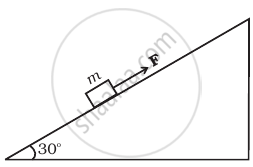
- work done against gravity
- work done against force of friction
- increase in potential energy
- increase in kinetic energy
- work done by applied force.
A block of mass m is taken from A to B slowly under the action of a constant force R Work done by this force is ______.

Work done by gas in cyclic process is ______ J.

A body is displaced from (0, 0) to (1 m, 1 m) along the path x = y by a force F = (x2`hat"J"` + y`hat"i"`)N. The work done by this force will be:
The work done by a variable force is calculated using the formula:
A particle of mass 'm' and charge 'q' is placed at rest in uniform electric field E and then released. The momentum gained by the particle after moving a distance 'y' is \[\sqrt{2x}.\] Then x is equal to ______.
A particle moves under the effect of a force F = Cx from x = 0 to x = x1. The work done in the process is ______.
