Advertisements
Advertisements
Question
Find the average force needed to accelerate a car weighing 500 kg from rest to 72 km/h through a distance of 25 m.
Advertisements
Solution
\[\text{ Given } : \]
\[\text{ Mass of the car, m = 500 kg }\]
\[\text{ Initial velocity of the car, u = 0 }\]
\[\text{ Final velocity of the car, } \nu = 72 \text{ km/h = 20 m/s }\]
\[a = \frac{\left( \nu^2 - u^2 \right)}{2s}\]
\[a = \frac{400}{50} = 8 \text{ m/ s}^2\]
Force needed to accelerate the car,
APPEARS IN
RELATED QUESTIONS
A body of mass m is placed on a table. The earth is pulling the body with a force mg. Taking this force to be the action what is the reaction?
A boy is sitting on a chair placed on the floor of a room. Write as many action-reaction pairs of forces as you can.
When you hold a pen and write on your notebook, what kind of force is exerted by you on the pen? By the pen on the notebook? By you on the notebook?
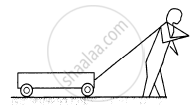
Figure shows a boy pulling a wagon on a road. List as many forces as you can which are relevant with this figure. Find the pairs of forces connected by Newton's third law of motion.
A 60 kg man pushes a 40 kg man by a force of 60 N. The 40 kg man has pushed the other man with a force of
At what distance should two charges, each equal to 1 C, be placed so that the force between them equals your weight ?
Find the ratio of the magnitude of the electric force to the gravitational force acting between two protons.
A block of mass m slides down a smooth vertical circular track. During the motion, the block is in
A particle moves from a point \[\overrightarrow{r}_1 = \left( 2 m \right) \overrightarrow{ i } + \left( 3 m \right) \overrightarrow{ j } \] to another point
\[\overrightarrow{r}_2 = \left( 3 m \right) \overrightarrow{ i } + \left( 2 m \right) \overrightarrow{ j } \] acts on it. Find the work done by the force on the particle during the displacement.
A block of mass 250 g slides down an incline of inclination 37° with uniform speed. Find the work done against friction as the block slides through 1m.
A box weighing 2000 N is to be slowly slid through 20 m on a straight track with friction coefficient 0⋅2 with the box. (a) Find the work done by the person pulling the box with a chain at an angle θ with the horizontal. (b) Find the work when the person has chosen a value of θ, which ensures him the minimum magnitude of the force.
A particle of mass m moves on a straight line with its velocity varying with the distance travelled, according to the equation \[\nu = a\sqrt{x}\] , where a is a constant. Find the total work done by all the forces during a displacement from \[x = 0 \text{ to } x - d\] .
Water falling from a 50-m high fall is to be used for generating electric energy. If \[1 \cdot 8 \times {10}^5 \text{ kg } \] of water falls per hour and half the gravitational potential energy can be converted into electrical energy, how many 100 W lamps can be lit with the generated energy?
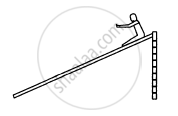
In a children's park, there is a slide which has a total length of 10 m and a height of 8⋅0 m . A vertical ladder is provided to reach the top. A boy weighing 200 N climbs up the ladder to the top of the slide and slides down to the ground. The average friction offered by the slide is three tenth of his weight. Find (a) the work done by the ladder on the boy as he goes up; (b) the work done by the slide on the boy as he comes down. Neglect any work done by forces inside the body of the boy
The work done by an applied variable force, F = x + x3 from x = 0 m to x = 2m, where x is displacement, is:
A lawn roller is pulled along a horizontal surface through a distance of 20 m by a rope with a force of 200 N. If the rope makes an angle of 60° with the vertical while pulling, the amount of work done by the pulling force is:
Work done by gas in cyclic process is ______ J.

A cylinder of area 300 cm2 and length 10 cm made of material of specific gravity 0.8 is floated in water with its axis vertical. It is then pushed downward, so as to be just immersed. The work done by the agent who pushes the cylinder into the water is ______ J.
A body is displaced from (0, 0) to (1 m, 1 m) along the path x = y by a force F = (x2`hat"J"` + y`hat"i"`)N. The work done by this force will be:
