Advertisements
Advertisements
Question
A 60 kg man pushes a 40 kg man by a force of 60 N. The 40 kg man has pushed the other man with a force of
Options
40 N
0 N
60 N
20 N
Advertisements
Solution
60 N
According to Newton's third law, which states that an action-reaction pair of forces are equal in magnitude, the man who weighs 40 kg will push the other man with the same force of 60 N.
APPEARS IN
RELATED QUESTIONS
A body constrained to move along the z-axis of a coordinate system is subject to a constant force F given by
`F = -hati+2hatj+3hatkN`
Where `hati,hatj,hatk` are unit vectors along the x-, y- and z-axis of the system respectively. What is the work done by this force in moving the body a distance of 4 m along the z-axis ?
A boy is sitting on a chair placed on the floor of a room. Write as many action-reaction pairs of forces as you can.
Is it true that the reaction of a gravitational force is always gravitational, of an electromagnetic force is always electromagnetic and so on?
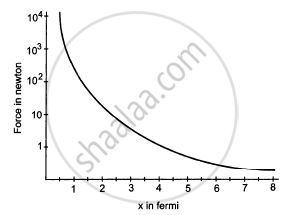
Suppose the magnitude of Nuclear force between two protons varies with the distance between them as shown in figure. Estimate the ratio "Nuclear force/Coulomb force" for
(a) x = 8 fm
(b) x = 4 fm
(c) x = 2 fm
(d) x = 1 fm (1 fm = 10 −15m).
The sum of all electromagnetic forces between different particles of a system of charged particles is zero
A proton exerts a force on a proton which is
(a) gravitational
(b) electromagnetic
(c) nuclear
(d) weak
If all matters were made of electrically neutral particles such as neutrons,
(a) there would be no force of friction
(b) there would be no tension in the string
(c) it would not be possible to sit on a chair
(d) the earth could not move around the sun.
The gravitational force acting on a particle of 1 g due to a similar particle is equal to 6.67 × 10⁻¹⁷ N. Calculate the separation between the particles.
A particle is acted upon by a force of constant magnitude which is always perpendicular to the velocity of the plane. The motion of the particle takes place in a plane. It follows that
(a) its velocity is constant
(b) its acceleration is constant
(c) its kinetic energy is constant
(d) it moves in a circular path.
A man moves on a straight horizontal road with a block of mass 2 kg in his hand. If he covers a distance of 40 m with an acceleration of 0⋅5 m/s2, find the work done by the man on the block during the motion.
Water falling from a 50-m high fall is to be used for generating electric energy. If \[1 \cdot 8 \times {10}^5 \text{ kg } \] of water falls per hour and half the gravitational potential energy can be converted into electrical energy, how many 100 W lamps can be lit with the generated energy?
A uniform chain of mass m and length l overhangs a table with its two third part on the table. Find the work to be done by a person to put the hanging part back on the table.
A uniform chain of length L and mass M overhangs a horizontal table with its two third part on the table. The friction coefficient between the table and the chain is μ . Find the work done by friction during the period the chain slips off the table.
A particle of mass m is kept on a fixed, smooth sphere of radius R at a position where the radius through the particle makes an angle of 30° with the vertical. The particle is released from this position. (a) What is the force exerted by the sphere on the particle just after the release? (b) Find the distance travelled by the particle before it loses contact with the sphere.
A body is moving unidirectionally under the influence of a source of constant power supplying energy. Which of the diagrams shown in figure correctly shows the displacement-time curve for its motion?
Force acting on a particle is (2`hat"i"` + 3 `hat"j"`) N. Work done by this force is zero, when a particle is moved on the line 3y + kx = 5. Here value of k is ______.
The work done by a variable force is calculated using the formula:
When force varies non-linearly with displacement, what method must be used to find work?
A particle moves under the effect of a force F = Cx from x = 0 to x = x1. The work done in the process is ______.
