Advertisements
Advertisements
Question
A particle of mass m is kept on a fixed, smooth sphere of radius R at a position where the radius through the particle makes an angle of 30° with the vertical. The particle is released from this position. (a) What is the force exerted by the sphere on the particle just after the release? (b) Find the distance travelled by the particle before it loses contact with the sphere.
Advertisements
Solution
(a) When the particle is released from rest, the centrifugal force is zero.
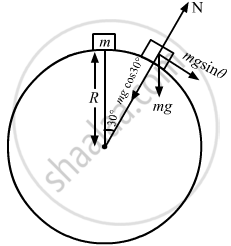
\[\text{N force = mg }\cos \theta = \text{ mg } \cos 30^\circ\]
\[ = \frac{\sqrt{3}}{2} \text{ mg }\]
(b) Consider that the particle loses contact with the surface at a point whose angle with the horizontal is θ .
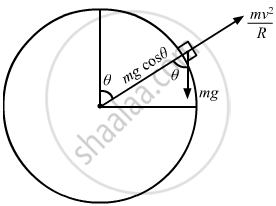
\[\text{So}, \frac{\text{m}\nu^2}{R} = \text{mg}\cos \theta\]
\[ \Rightarrow \nu^2 = \text{Rg} \cos \theta . . . (i)\]
\[\text{Again,} \left( \frac{1}{2} \right) \text{m} \nu^2 = \text{ mg }R \left( \cos 30^\circ- \cos \theta \right)\]
\[ \Rightarrow \nu^2 = 2\text{ Rg }\left( \frac{\sqrt{3}}{2} - \cos \theta \right) . . . (\text{ii})\]
From equations (i) and (ii),
\[ \Rightarrow \cos \theta = \frac{1}{\sqrt{3}}\]
\[\text{ or } \theta = \cos^{- 1} \frac{1}{\sqrt{3}}\]
\[L = R \left( \theta - \frac{\pi}{6} \right)\]
\[ \left[ \text{ because }30^\circ= \left( \frac{\pi}{6} \right) \right]\]
Putting the value of θ, we get:
L = 0.43 R
APPEARS IN
RELATED QUESTIONS
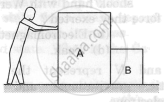
List all the forces acting on the block B in figure.
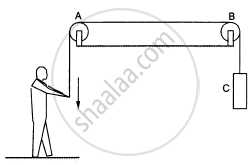
List all the forces acting on (a) the pulley A, (b) the boy and (c) the block C in figure.
Mark the correct statements :
(a) The nuclear force between two protons is always greater than the electromagnetic force between them.
(b) The electromagnetic force between two protons is always greater than the gravitational force between them.
(c) The gravitational force between two protons may be greater than the nuclear force between them.
(d) Electromagnetic force between two protons may be greater than the nuclear force acting between them.
Which of the following systems may be adequately described by classical physics ?
(a) motion of a cricket ball
(b) motion of a dust particle
(c) a hydrogen atom
(d) a neutron changing to a proton.
The gravitational force acting on a particle of 1 g due to a similar particle is equal to 6.67 × 10⁻¹⁷ N. Calculate the separation between the particles.
At what distance should two charges, each equal to 1 C, be placed so that the force between them equals your weight ?
A body builder exerts a force of 150 N against a bullworker and compresses it by 20 cm. Calculate the spring constant of the spring in the bullworker.
Two charged particles placed at a separation of 20 cm exert 20 N of Coulomb force on each other. What will be the force of the separation is increased to 25 cm?
In tug of war, the team that exerts a larger tangential force on the ground wins. Consider the period in which a team is dragging the opposite team by applying a larger tangential force on the ground. List which of the following works are positive, which are negative and which are zero?
(a) work by the winning team on the losing team
(b) work by the losing team on the winning team
(c) work by the ground on the winning team
(d) work by the ground on the losing team
(e) total external work on the two teams.
The work done by the external forces on a system equals the change in
A small block of mass m is kept on a rough inclined surface of inclination θ fixed in an elevator. the elevator goes up with a uniform velocity v and the block does not slide on the wedge. The work done by the force of friction on the block in time t will be
A box is pushed through 4.0 m across a floor offering 100 N resistance. How much work is done by the resisting force?
A particle of mass m moves on a straight line with its velocity varying with the distance travelled, according to the equation \[\nu = a\sqrt{x}\] , where a is a constant. Find the total work done by all the forces during a displacement from \[x = 0 \text{ to } x - d\] .
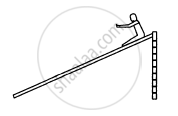
In a children's park, there is a slide which has a total length of 10 m and a height of 8⋅0 m . A vertical ladder is provided to reach the top. A boy weighing 200 N climbs up the ladder to the top of the slide and slides down to the ground. The average friction offered by the slide is three tenth of his weight. Find (a) the work done by the ladder on the boy as he goes up; (b) the work done by the slide on the boy as he comes down. Neglect any work done by forces inside the body of the boy
A lawn roller is pulled along a horizontal surface through a distance of 20 m by a rope with a force of 200 N. If the rope makes an angle of 60° with the vertical while pulling, the amount of work done by the pulling force is:
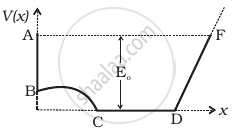
A graph of potential energy V(x) verses x is shown in figure. A particle of energy E0 is executing motion in it. Draw graph of velocity and kinetic energy versus x for one complete cycle AFA.
A block of mass m is taken from A to B slowly under the action of a constant force R Work done by this force is ______.

A body is displaced from (0, 0) to (1 m, 1 m) along the path x = y by a force F = (x2`hat"J"` + y`hat"i"`)N. The work done by this force will be:
