Advertisements
Advertisements
Question
A body constrained to move along the z-axis of a coordinate system is subject to a constant force F given by
`F = -hati+2hatj+3hatkN`
Where `hati,hatj,hatk` are unit vectors along the x-, y- and z-axis of the system respectively. What is the work done by this force in moving the body a distance of 4 m along the z-axis ?
Advertisements
Solution
Since the body is displaced 4m among z-axis only.
`:. hatS = 0hati +0hatj+4hatk`
Also `vecF = -hati +2hatj + 3hatk`
Work Done, `W = vecF.vecS`
`= (-hati+2hatj+3hatk).(0hati+0hatj+4hatk)`
`= 12 (hatk.hatk)` joule = 12 Joule
APPEARS IN
RELATED QUESTIONS
A boy is sitting on a chair placed on the floor of a room. Write as many action-reaction pairs of forces as you can.
A lawyer alleges in court that the police had forced his client to issue a statement of confession. What kind of force is this ?
When you hold a pen and write on your notebook, what kind of force is exerted by you on the pen? By the pen on the notebook? By you on the notebook?
Is it true that the reaction of a gravitational force is always gravitational, of an electromagnetic force is always electromagnetic and so on?
When Neils Bohr shook hand with Werner Heisenberg, what kind of force they exerted ?
Let E, G and N represent the magnitudes of electromagnetic gravitational and nuclear forces between two electrons at a given separation. Then
Which of the following systems may be adequately described by classical physics ?
(a) motion of a cricket ball
(b) motion of a dust particle
(c) a hydrogen atom
(d) a neutron changing to a proton.
A body builder exerts a force of 150 N against a bullworker and compresses it by 20 cm. Calculate the spring constant of the spring in the bullworker.
A block of mass m slides down a smooth vertical circular track. During the motion, the block is in
A particle moves from a point \[\overrightarrow{r}_1 = \left( 2 m \right) \overrightarrow{ i } + \left( 3 m \right) \overrightarrow{ j } \] to another point
\[\overrightarrow{r}_2 = \left( 3 m \right) \overrightarrow{ i } + \left( 2 m \right) \overrightarrow{ j } \] acts on it. Find the work done by the force on the particle during the displacement.
A box weighing 2000 N is to be slowly slid through 20 m on a straight track with friction coefficient 0⋅2 with the box. (a) Find the work done by the person pulling the box with a chain at an angle θ with the horizontal. (b) Find the work when the person has chosen a value of θ, which ensures him the minimum magnitude of the force.
Find the average force needed to accelerate a car weighing 500 kg from rest to 72 km/h through a distance of 25 m.
Water falling from a 50-m high fall is to be used for generating electric energy. If \[1 \cdot 8 \times {10}^5 \text{ kg } \] of water falls per hour and half the gravitational potential energy can be converted into electrical energy, how many 100 W lamps can be lit with the generated energy?
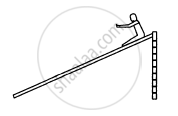
In a children's park, there is a slide which has a total length of 10 m and a height of 8⋅0 m . A vertical ladder is provided to reach the top. A boy weighing 200 N climbs up the ladder to the top of the slide and slides down to the ground. The average friction offered by the slide is three tenth of his weight. Find (a) the work done by the ladder on the boy as he goes up; (b) the work done by the slide on the boy as he comes down. Neglect any work done by forces inside the body of the boy
A force F = 20 + 10y acts on a particle in y-direction where F is in newton and y in metre. Work done by this force to move the particle from y – 0 to y – 1 m is:
A bicyclist comes to a skidding stop in 10 m. During this process, the force on the bicycle due to the road is 200 N and is directly opposed to the motion. The work done by the cycle on the road is ______.
A body is being raised to a height h from the surface of earth. What is the sign of work done by gravitational force?
A body is displaced from (0, 0) to (1 m, 1 m) along the path x = y by a force F = (x2`hat"J"` + y`hat"i"`)N. The work done by this force will be:
The work done by a variable force is calculated using the formula:
