Advertisements
Advertisements
Question
Which of the following systems may be adequately described by classical physics ?
(a) motion of a cricket ball
(b) motion of a dust particle
(c) a hydrogen atom
(d) a neutron changing to a proton.
Advertisements
Solution
(a) motion of a cricket ball
(b) motion of a dust particle
Classical physics adequately describes the motion of a ball and the motion of dust particles. It also describes Newton's law of motion, Newton's law of gravitation, Laws of thermodynamics, Maxwell's electromagnetism and Lorentz force. Classical physics easily describes the system of heavenly bodies like the Sun, the Earth and the Moon. However, it is inadequate for describing systems of particles which have sizes much smaller than \[{10}^{- 6} m\] (e.g., atom, nuclei and other elementary particles).
APPEARS IN
RELATED QUESTIONS
State if the following statement is true or false. Give a reason for your answer.
Work done in the motion of a body over a closed loop is zero for every force in nature.
A boy is sitting on a chair placed on the floor of a room. Write as many action-reaction pairs of forces as you can.
Is it true that the reaction of a gravitational force is always gravitational, of an electromagnetic force is always electromagnetic and so on?
List all the forces acting on the block B in figure.
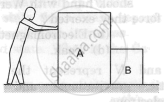
A 60 kg man pushes a 40 kg man by a force of 60 N. The 40 kg man has pushed the other man with a force of
Two spherical bodies, each of mass 50 kg, are placed at a separation of 20 cm. Equal charges are placed on the bodies and it is found that the force of Coulomb repulsion equals the gravitational attraction in magnitude. Find the magnitude of the charge placed on either body.
Find the ratio of the magnitude of the electric force to the gravitational force acting between two protons.
A particle is acted upon by a force of constant magnitude which is always perpendicular to the velocity of the plane. The motion of the particle takes place in a plane. It follows that
(a) its velocity is constant
(b) its acceleration is constant
(c) its kinetic energy is constant
(d) it moves in a circular path.
A man moves on a straight horizontal road with a block of mass 2 kg in his hand. If he covers a distance of 40 m with an acceleration of 0⋅5 m/s2, find the work done by the man on the block during the motion.
Find the average force needed to accelerate a car weighing 500 kg from rest to 72 km/h through a distance of 25 m.
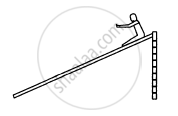
In a children's park, there is a slide which has a total length of 10 m and a height of 8⋅0 m . A vertical ladder is provided to reach the top. A boy weighing 200 N climbs up the ladder to the top of the slide and slides down to the ground. The average friction offered by the slide is three tenth of his weight. Find (a) the work done by the ladder on the boy as he goes up; (b) the work done by the slide on the boy as he comes down. Neglect any work done by forces inside the body of the boy
A uniform chain of length L and mass M overhangs a horizontal table with its two third part on the table. The friction coefficient between the table and the chain is μ . Find the work done by friction during the period the chain slips off the table.
A bicyclist comes to a skidding stop in 10 m. During this process, the force on the bicycle due to the road is 200 N and is directly opposed to the motion. The work done by the cycle on the road is ______.
A body is being raised to a height h from the surface of earth. What is the sign of work done by gravitational force?
A cylinder of area 300 cm2 and length 10 cm made of material of specific gravity 0.8 is floated in water with its axis vertical. It is then pushed downward, so as to be just immersed. The work done by the agent who pushes the cylinder into the water is ______ J.
A body is displaced from (0, 0) to (1 m, 1 m) along the path x = y by a force F = (x2`hat"J"` + y`hat"i"`)N. The work done by this force will be:
The work done by a variable force is calculated using the formula:
When force varies non-linearly with displacement, what method must be used to find work?
A particle moves under the effect of a force F = Cx from x = 0 to x = x1. The work done in the process is ______.
