Advertisements
Advertisements
प्रश्न
Which of the following systems may be adequately described by classical physics ?
(a) motion of a cricket ball
(b) motion of a dust particle
(c) a hydrogen atom
(d) a neutron changing to a proton.
Advertisements
उत्तर
(a) motion of a cricket ball
(b) motion of a dust particle
Classical physics adequately describes the motion of a ball and the motion of dust particles. It also describes Newton's law of motion, Newton's law of gravitation, Laws of thermodynamics, Maxwell's electromagnetism and Lorentz force. Classical physics easily describes the system of heavenly bodies like the Sun, the Earth and the Moon. However, it is inadequate for describing systems of particles which have sizes much smaller than \[{10}^{- 6} m\] (e.g., atom, nuclei and other elementary particles).
APPEARS IN
संबंधित प्रश्न
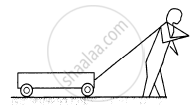
Figure shows a boy pulling a wagon on a road. List as many forces as you can which are relevant with this figure. Find the pairs of forces connected by Newton's third law of motion.
A 60 kg man pushes a 40 kg man by a force of 60 N. The 40 kg man has pushed the other man with a force of
If all matters were made of electrically neutral particles such as neutrons,
(a) there would be no force of friction
(b) there would be no tension in the string
(c) it would not be possible to sit on a chair
(d) the earth could not move around the sun.
Calculate the force with which you attract the earth.
At what distance should two charges, each equal to 1 C, be placed so that the force between them equals your weight ?
Two spherical bodies, each of mass 50 kg, are placed at a separation of 20 cm. Equal charges are placed on the bodies and it is found that the force of Coulomb repulsion equals the gravitational attraction in magnitude. Find the magnitude of the charge placed on either body.
Two charged particles placed at a separation of 20 cm exert 20 N of Coulomb force on each other. What will be the force of the separation is increased to 25 cm?
A small block of mass m is kept on a rough inclined surface of inclination θ fixed in an elevator. the elevator goes up with a uniform velocity v and the block does not slide on the wedge. The work done by the force of friction on the block in time t will be
A block of mass m slides down a smooth vertical circular track. During the motion, the block is in
No work is done by a force on an object if
(a) the force is always perpendicular to its velocity
(b) the force is always perpendicular to its acceleration
(c) the object is stationary but the point of application of the force moves on the object
(d) the object moves in such a way that the point of application of the force remains fixed.
Find the average force needed to accelerate a car weighing 500 kg from rest to 72 km/h through a distance of 25 m.
A block of mass 2 kg kept at rest on an inclined plane of inclination 37° is pulled up the plane by applying a constant force of 20 N parallel to the incline. The force acts for one second. Show that the work done by the applied force does not exceed 40 J.
A particle of mass m is kept on a fixed, smooth sphere of radius R at a position where the radius through the particle makes an angle of 30° with the vertical. The particle is released from this position. (a) What is the force exerted by the sphere on the particle just after the release? (b) Find the distance travelled by the particle before it loses contact with the sphere.
A lawn roller is pulled along a horizontal surface through a distance of 20 m by a rope with a force of 200 N. If the rope makes an angle of 60° with the vertical while pulling, the amount of work done by the pulling force is:
A body is being raised to a height h from the surface of earth. What is the sign of work done by gravitational force?
Work done by gas in cyclic process is ______ J.

The work done by a variable force is calculated using the formula:
When force varies non-linearly with displacement, what method must be used to find work?
A particle moves under the effect of a force F = Cx from x = 0 to x = x1. The work done in the process is ______.
