Advertisements
Advertisements
प्रश्न
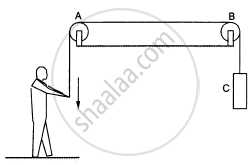
List all the forces acting on (a) the pulley A, (b) the boy and (c) the block C in figure.
Advertisements
उत्तर
Forces acting on the pulley A :
- A tension exerts electromagnetic force between the string and pulley A.
- A pair of gravitational force between the Earth and pulley.
Forces acting on the boy :
- A tension exerts electromagnetic force between the string and the boy.
- A pair of gravitational force between the Earth and the boy.
Forces acting on the block C :
- A tension exerts electromagnetic force between the string and block C.
- A pair gravitational force between block C and the Earth.
APPEARS IN
संबंधित प्रश्न
Is it true that the reaction of a gravitational force is always gravitational, of an electromagnetic force is always electromagnetic and so on?
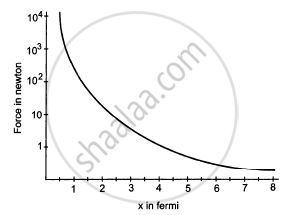
Suppose the magnitude of Nuclear force between two protons varies with the distance between them as shown in figure. Estimate the ratio "Nuclear force/Coulomb force" for
(a) x = 8 fm
(b) x = 4 fm
(c) x = 2 fm
(d) x = 1 fm (1 fm = 10 −15m).
Let E, G and N represent the magnitudes of electromagnetic gravitational and nuclear forces between two electrons at a given separation. Then
The sum of all electromagnetic forces between different particles of a system of charged particles is zero
A neutron exerts a force on a proton which is
(a) gravitational
(b) electromagnetic
(c) nuclear
(d) weak
Which of the following systems may be adequately described by classical physics ?
(a) motion of a cricket ball
(b) motion of a dust particle
(c) a hydrogen atom
(d) a neutron changing to a proton.
The average separation between the proton and the electron in a hydrogen atom in ground state is 5.3 × 10⁻¹¹ m. (a) Calculate the Coulomb force between them at this separation. (b) When the atom goes into its first excited state the average separation between the proton and the electron increases to four times its value in the ground state. What is the Coulomb force in this state?
The work done by all the forces (external and internal) on a system equals the change in ______.
A box is pushed through 4.0 m across a floor offering 100 N resistance. How much work is done by the resisting force?
A block of mass 2 kg kept at rest on an inclined plane of inclination 37° is pulled up the plane by applying a constant force of 20 N parallel to the incline. The force acts for one second. Find the work done by the force of gravity in that one second if the work done by the applied force is 40 J.
Water falling from a 50-m high fall is to be used for generating electric energy. If \[1 \cdot 8 \times {10}^5 \text{ kg } \] of water falls per hour and half the gravitational potential energy can be converted into electrical energy, how many 100 W lamps can be lit with the generated energy?
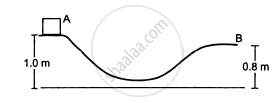
A block of mass 1 kg is placed at point A of a rough track shown in figure following. If slightly pushed towards right, it stops at point B of the track. Calculate the work done by the frictional force on the block during its transit from A to B.
A force F = 20 + 10y acts on a particle in y-direction where F is in newton and y in metre. Work done by this force to move the particle from y – 0 to y – 1 m is:
A body of mass 0.5 kg travels in a straight line with velocity v = a x3/2 where a = 5 m–1/2s–1. The work done by the net force during its displacement from x = 0 to x = 2 m is ______.
A body is being raised to a height h from the surface of earth. What is the sign of work done by applied force?
In the integration method for variable force, why do we divide displacement into tiny segments (ds)?
The work done by a variable force is calculated using the formula:
When force varies non-linearly with displacement, what method must be used to find work?
A particle moves under the effect of a force F = Cx from x = 0 to x = x1. The work done in the process is ______.
