Advertisements
Advertisements
प्रश्न
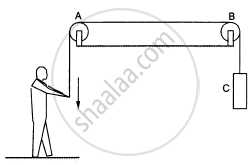
List all the forces acting on (a) the pulley A, (b) the boy and (c) the block C in figure.
Advertisements
उत्तर
Forces acting on the pulley A :
- A tension exerts electromagnetic force between the string and pulley A.
- A pair of gravitational force between the Earth and pulley.
Forces acting on the boy :
- A tension exerts electromagnetic force between the string and the boy.
- A pair of gravitational force between the Earth and the boy.
Forces acting on the block C :
- A tension exerts electromagnetic force between the string and block C.
- A pair gravitational force between block C and the Earth.
APPEARS IN
संबंधित प्रश्न
A body constrained to move along the z-axis of a coordinate system is subject to a constant force F given by
`F = -hati+2hatj+3hatkN`
Where `hati,hatj,hatk` are unit vectors along the x-, y- and z-axis of the system respectively. What is the work done by this force in moving the body a distance of 4 m along the z-axis ?
Let E, G and N represent the magnitudes of electromagnetic gravitational and nuclear forces between two electrons at a given separation. Then
A 60 kg man pushes a 40 kg man by a force of 60 N. The 40 kg man has pushed the other man with a force of
The gravitational force acting on a particle of 1 g due to a similar particle is equal to 6.67 × 10⁻¹⁷ N. Calculate the separation between the particles.
Two spherical bodies, each of mass 50 kg, are placed at a separation of 20 cm. Equal charges are placed on the bodies and it is found that the force of Coulomb repulsion equals the gravitational attraction in magnitude. Find the magnitude of the charge placed on either body.
Find the ratio of the magnitude of the electric force to the gravitational force acting between two protons.
In tug of war, the team that exerts a larger tangential force on the ground wins. Consider the period in which a team is dragging the opposite team by applying a larger tangential force on the ground. List which of the following works are positive, which are negative and which are zero?
(a) work by the winning team on the losing team
(b) work by the losing team on the winning team
(c) work by the ground on the winning team
(d) work by the ground on the losing team
(e) total external work on the two teams.
A block of mass m slides down a smooth vertical circular track. During the motion, the block is in
A constant force of 2⋅5 N accelerates a stationary particle of mass 15 g through a displacement of 2⋅5 m. Find the work done and the average power delivered.
A block of mass 250 g slides down an incline of inclination 37° with uniform speed. Find the work done against friction as the block slides through 1m.
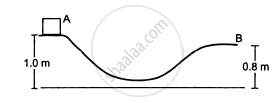
A block of mass 1 kg is placed at point A of a rough track shown in figure following. If slightly pushed towards right, it stops at point B of the track. Calculate the work done by the frictional force on the block during its transit from A to B.
The work done by an applied variable force, F = x + x3 from x = 0 m to x = 2m, where x is displacement, is:
A body of mass 0.5 kg travels in a straight line with velocity v = a x3/2 where a = 5 m–1/2s–1. The work done by the net force during its displacement from x = 0 to x = 2 m is ______.
A body is being raised to a height h from the surface of earth. What is the sign of work done by applied force?
A body is being raised to a height h from the surface of earth. What is the sign of work done by gravitational force?
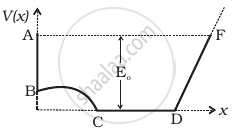
A graph of potential energy V(x) verses x is shown in figure. A particle of energy E0 is executing motion in it. Draw graph of velocity and kinetic energy versus x for one complete cycle AFA.
A block of mass 1 kg is pushed up a surface inclined to horizontal at an angle of 30° by a force of 10 N parallel to the inclined surface (Figure). The coefficient of friction between block and the incline is 0.1. If the block is pushed up by 10 m along the incline, calulate
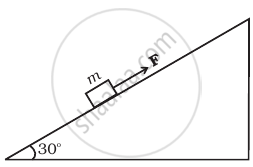
- work done against gravity
- work done against force of friction
- increase in potential energy
- increase in kinetic energy
- work done by applied force.
In the integration method for variable force, why do we divide displacement into tiny segments (ds)?
If a force varies linearly with displacement, the area under the F-s graph forms:
When force varies non-linearly with displacement, what method must be used to find work?
