Advertisements
Advertisements
प्रश्न
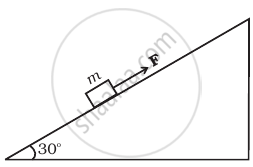
A block of mass 1 kg is pushed up a surface inclined to horizontal at an angle of 30° by a force of 10 N parallel to the inclined surface (Figure). The coefficient of friction between block and the incline is 0.1. If the block is pushed up by 10 m along the incline, calulate
- work done against gravity
- work done against force of friction
- increase in potential energy
- increase in kinetic energy
- work done by applied force.
Advertisements
उत्तर
Consider the adjacent diagram the block is pushed up by applying a force F.
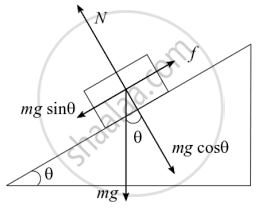
Normal reaction (N) and frictional force (f) is shown.
Given, mass = m = 1 kg, θ = 30°
F = 10 N, μ = 0.1 and s = distance moved by the block along the inclined plane = 10 m
a. Work done against gravity = Increase in PE of the block
= mg × Vertical distance travelled
= mg × s(sin θ) = (mgs) sin θ
= 1 × 10 × 10 × sin 30° = 50 j ....(∵ g ≤ 10 m/s2)
b. Work done against friction
wf = f × s = μN × s = μ mg cos θ × s
= 0.1 × 1 × 10 × cos 30° × 10
= 10 × 0.866
= 8.66 J
c. Increase in PE = mgh = mg (s sin θ)
= 1 × 10 × 10 × sin 30°
= `100 xx 1/2`
= 50 J
d. By the work-energy theorem, we know that work done by all the forces = change in KE
(W) = ΔK
ΔK = Wg + Wf + Wf
⇒ = – mgh – fs + FS
= – 50 – 8.66 + 10 × 10
= – 50 – 8.66
= 41.34 J
e. Work done by the applied force, F = FS
= (10)(10)
= 100 J
APPEARS IN
संबंधित प्रश्न
A body of mass m is placed on a table. The earth is pulling the body with a force mg. Taking this force to be the action what is the reaction?
List all the forces acting on the block B in figure.
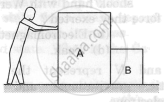
List all the forces acting on (a) the pulley A, (b) the boy and (c) the block C in figure.
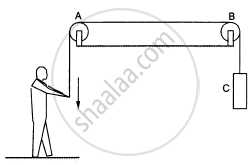
Figure shows a cart. Complete the table shown below.
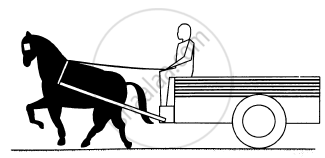
| Force on | Force by | Nature of the Force | Direction |
| Cart |
1 |
||
| Horse |
1 |
||
| Driver |
1 |
Let E, G and N represent the magnitudes of electromagnetic gravitational and nuclear forces between two electrons at a given separation. Then
A neutron exerts a force on a proton which is
(a) gravitational
(b) electromagnetic
(c) nuclear
(d) weak
At what distance should two charges, each equal to 1 C, be placed so that the force between them equals your weight ?
The work done by the external forces on a system equals the change in
A box weighing 2000 N is to be slowly slid through 20 m on a straight track with friction coefficient 0⋅2 with the box. (a) Find the work done by the person pulling the box with a chain at an angle θ with the horizontal. (b) Find the work when the person has chosen a value of θ, which ensures him the minimum magnitude of the force.
A particle of mass m moves on a straight line with its velocity varying with the distance travelled, according to the equation \[\nu = a\sqrt{x}\] , where a is a constant. Find the total work done by all the forces during a displacement from \[x = 0 \text{ to } x - d\] .
A uniform chain of mass m and length l overhangs a table with its two third part on the table. Find the work to be done by a person to put the hanging part back on the table.
A uniform chain of length L and mass M overhangs a horizontal table with its two third part on the table. The friction coefficient between the table and the chain is μ . Find the work done by friction during the period the chain slips off the table.
A particle of mass m is kept on a fixed, smooth sphere of radius R at a position where the radius through the particle makes an angle of 30° with the vertical. The particle is released from this position. (a) What is the force exerted by the sphere on the particle just after the release? (b) Find the distance travelled by the particle before it loses contact with the sphere.
A lawn roller is pulled along a horizontal surface through a distance of 20 m by a rope with a force of 200 N. If the rope makes an angle of 60° with the vertical while pulling, the amount of work done by the pulling force is:
Force acting on a particle is (2`hat"i"` + 3 `hat"j"`) N. Work done by this force is zero, when a particle is moved on the line 3y + kx = 5. Here value of k is ______.
A body is displaced from (0, 0) to (1 m, 1 m) along the path x = y by a force F = (x2`hat"J"` + y`hat"i"`)N. The work done by this force will be:
In the integration method for variable force, why do we divide displacement into tiny segments (ds)?
What does 'dW' represent in the variable force work calculation?
A particle of mass 'm' and charge 'q' is placed at rest in uniform electric field E and then released. The momentum gained by the particle after moving a distance 'y' is \[\sqrt{2x}.\] Then x is equal to ______.
