Advertisements
Advertisements
प्रश्न
A block of mass 1 kg is pushed up a surface inclined to horizontal at an angle of 30° by a force of 10 N parallel to the inclined surface (Figure). The coefficient of friction between block and the incline is 0.1. If the block is pushed up by 10 m along the incline, calulate
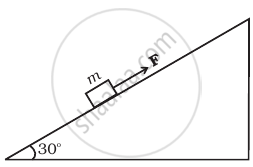
- work done against gravity
- work done against force of friction
- increase in potential energy
- increase in kinetic energy
- work done by applied force.
Advertisements
उत्तर
Consider the adjacent diagram the block is pushed up by applying a force F.
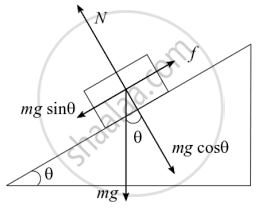
Normal reaction (N) and frictional force (f) is shown.
Given, mass = m = 1 kg, θ = 30°
F = 10 N, μ = 0.1 and s = distance moved by the block along the inclined plane = 10 m
a. Work done against gravity = Increase in PE of the block
= mg × Vertical distance travelled
= mg × s(sin θ) = (mgs) sin θ
= 1 × 10 × 10 × sin 30° = 50 j ....(∵ g ≤ 10 m/s2)
b. Work done against friction
wf = f × s = μN × s = μ mg cos θ × s
= 0.1 × 1 × 10 × cos 30° × 10
= 10 × 0.866
= 8.66 J
c. Increase in PE = mgh = mg (s sin θ)
= 1 × 10 × 10 × sin 30°
= `100 xx 1/2`
= 50 J
d. By the work-energy theorem, we know that work done by all the forces = change in KE
(W) = ΔK
ΔK = Wg + Wf + Wf
⇒ = – mgh – fs + FS
= – 50 – 8.66 + 10 × 10
= – 50 – 8.66
= 41.34 J
e. Work done by the applied force, F = FS
= (10)(10)
= 100 J
APPEARS IN
संबंधित प्रश्न
State if the following statement is true or false. Give a reason for your answer.
Work done in the motion of a body over a closed loop is zero for every force in nature.
When you hold a pen and write on your notebook, what kind of force is exerted by you on the pen? By the pen on the notebook? By you on the notebook?
The sum of all electromagnetic forces between different particles of a system of charged particles is zero
Two spherical bodies, each of mass 50 kg, are placed at a separation of 20 cm. Equal charges are placed on the bodies and it is found that the force of Coulomb repulsion equals the gravitational attraction in magnitude. Find the magnitude of the charge placed on either body.
Two charged particles placed at a separation of 20 cm exert 20 N of Coulomb force on each other. What will be the force of the separation is increased to 25 cm?
The magnetic force on a charged particle is always perpendicular to its velocity. Can the magnetic force change the velocity of the particles? Speed of the particle?
A small block of mass m is kept on a rough inclined surface of inclination θ fixed in an elevator. the elevator goes up with a uniform velocity v and the block does not slide on the wedge. The work done by the force of friction on the block in time t will be
A particle moves from a point \[\overrightarrow{r}_1 = \left( 2 m \right) \overrightarrow{ i } + \left( 3 m \right) \overrightarrow{ j } \] to another point
\[\overrightarrow{r}_2 = \left( 3 m \right) \overrightarrow{ i } + \left( 2 m \right) \overrightarrow{ j } \] acts on it. Find the work done by the force on the particle during the displacement.
A man moves on a straight horizontal road with a block of mass 2 kg in his hand. If he covers a distance of 40 m with an acceleration of 0⋅5 m/s2, find the work done by the man on the block during the motion.
A force \[F = \alpha + bx\] acts on a particle in the x-direction, where a and b are constants. Find the work done by this force during a displacement from x = 0 to x = d.
A particle of mass m moves on a straight line with its velocity varying with the distance travelled, according to the equation \[\nu = a\sqrt{x}\] , where a is a constant. Find the total work done by all the forces during a displacement from \[x = 0 \text{ to } x - d\] .
A uniform chain of mass m and length l overhangs a table with its two third part on the table. Find the work to be done by a person to put the hanging part back on the table.
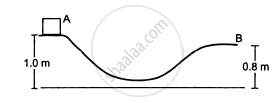
A block of mass 1 kg is placed at point A of a rough track shown in figure following. If slightly pushed towards right, it stops at point B of the track. Calculate the work done by the frictional force on the block during its transit from A to B.
A body is displaced from (0, 0) to (1 m, 1 m) along the path x = y by a force F = (x2`hat"J"` + y`hat"i"`)N. The work done by this force will be:
In the integration method for variable force, why do we divide displacement into tiny segments (ds)?
What does 'dW' represent in the variable force work calculation?
A particle of mass 'm' and charge 'q' is placed at rest in uniform electric field E and then released. The momentum gained by the particle after moving a distance 'y' is \[\sqrt{2x}.\] Then x is equal to ______.
A particle moves under the effect of a force F = Cx from x = 0 to x = x1. The work done in the process is ______.
