Advertisements
Advertisements
प्रश्न
A block of weight 100 N is slowly moved up a smooth incline of inclination 37° by a person. Calculate the work done by the person in moving the block through a distance of 2 m, if the driving force is (a) parallel to the incline and (b) in the horizontal direction.
Advertisements
उत्तर
Given :
\[\text{ Weight, mg = 100 N } \]
\[\theta = 37^\circ \text{ and s = 2 m }\]
\[\text{ Force, F = mg} \sin 37^\circ\]
\[ = 100 \times \frac{3}{5} = 60 N\]
So, work done when the force is parallel to incline,
\[W = FS \cos \theta\]
\[ = 60 \times 2 \times \cos 0^\circ= 120 J\]
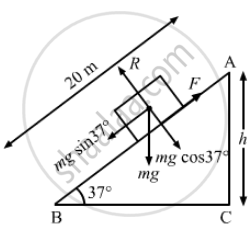
\[\text{ In } \Delta ABC, AB = 2 \text{ m } \]
\[AC = \text{ h }\]
\[ = s \times \sin 37^\circ= 2 . 0 \times \sin 37^\circ\]
\[ = 1 . 2 \text{ m } \]
∴ Work done when the force is in horizontal direction,
\[\text{ W' = mgh } \]
\[ = 100 \times 1 . 2 = 120 J\]
APPEARS IN
संबंधित प्रश्न
A lawyer alleges in court that the police had forced his client to issue a statement of confession. What kind of force is this ?
When you hold a pen and write on your notebook, what kind of force is exerted by you on the pen? By the pen on the notebook? By you on the notebook?
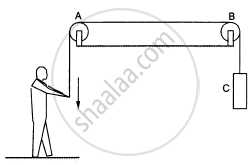
List all the forces acting on (a) the pulley A, (b) the boy and (c) the block C in figure.
When Neils Bohr shook hand with Werner Heisenberg, what kind of force they exerted ?
Let E, G and N represent the magnitudes of electromagnetic gravitational and nuclear forces between two electrons at a given separation. Then
A proton exerts a force on a proton which is
(a) gravitational
(b) electromagnetic
(c) nuclear
(d) weak
Which of the following systems may be adequately described by classical physics ?
(a) motion of a cricket ball
(b) motion of a dust particle
(c) a hydrogen atom
(d) a neutron changing to a proton.
A body builder exerts a force of 150 N against a bullworker and compresses it by 20 cm. Calculate the spring constant of the spring in the bullworker.
The force with which the earth attracts an object is called the weight of the object. Calculate the weight of the moon from the following data : The universal constant of gravitation G = 6.67 × 11−11 N−m2/kg2, mass of the moon = 7.36 × 10²² kg, mass of the earth = 6 × 1024 kg and the distance between the earth and the moon = 3.8 × 10⁵ km.
A particle moves from a point \[\overrightarrow{r}_1 = \left( 2 m \right) \overrightarrow{ i } + \left( 3 m \right) \overrightarrow{ j } \] to another point
\[\overrightarrow{r}_2 = \left( 3 m \right) \overrightarrow{ i } + \left( 2 m \right) \overrightarrow{ j } \] acts on it. Find the work done by the force on the particle during the displacement.
A particle of mass m moves on a straight line with its velocity varying with the distance travelled, according to the equation \[\nu = a\sqrt{x}\] , where a is a constant. Find the total work done by all the forces during a displacement from \[x = 0 \text{ to } x - d\] .
A block of mass 2 kg kept at rest on an inclined plane of inclination 37° is pulled up the plane by applying a constant force of 20 N parallel to the incline. The force acts for one second. Show that the work done by the applied force does not exceed 40 J.
A uniform chain of length L and mass M overhangs a horizontal table with its two third part on the table. The friction coefficient between the table and the chain is μ . Find the work done by friction during the period the chain slips off the table.
A body is being raised to a height h from the surface of earth. What is the sign of work done by gravitational force?
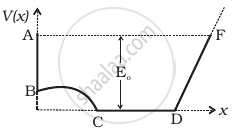
A graph of potential energy V(x) verses x is shown in figure. A particle of energy E0 is executing motion in it. Draw graph of velocity and kinetic energy versus x for one complete cycle AFA.
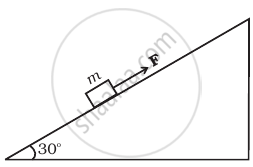
A block of mass 1 kg is pushed up a surface inclined to horizontal at an angle of 30° by a force of 10 N parallel to the inclined surface (Figure). The coefficient of friction between block and the incline is 0.1. If the block is pushed up by 10 m along the incline, calulate
- work done against gravity
- work done against force of friction
- increase in potential energy
- increase in kinetic energy
- work done by applied force.
Work done by gas in cyclic process is ______ J.

If a force varies linearly with displacement, the area under the F-s graph forms:
The work done by a variable force is calculated using the formula:
