Advertisements
Advertisements
प्रश्न
The gravitational force acting on a particle of 1 g due to a similar particle is equal to 6.67 × 10⁻¹⁷ N. Calculate the separation between the particles.
Advertisements
उत्तर
Mass of the particle, m = 1 gm \[= \frac{1}{1000} kg\]
Let the distance between the two particles be r.
Gravitational force between the particle, F = 6.67 × 10⁻¹⁷ N
Also, \[F = \frac{\text{ G m} _1 \text{ m }_2}{r^2}\]
Substituting the respective values in the above formula, we get :
\[6 . 67 \times {10}^{- 17} = \frac{6 . 67 \times {10}^{- 11} \times \left( 1/1000 \right) \times \left( 1/1000 \right)}{r^2}\]
\[ \Rightarrow r^2 = \frac{6 . 67 \times {10}^{- 6} \times {10}^{- 11}}{6 . 67 \times {10}^{- 17}}\]
\[ = \frac{{10}^{- 17}}{{10}^{- 17}} = 1\]
\[ \Rightarrow r = \sqrt{1} = 1 \text{ m }\]
∴ The separation between the particles is 1 m.
APPEARS IN
संबंधित प्रश्न
When you hold a pen and write on your notebook, what kind of force is exerted by you on the pen? By the pen on the notebook? By you on the notebook?
When Neils Bohr shook hand with Werner Heisenberg, what kind of force they exerted ?
A proton exerts a force on a proton which is
(a) gravitational
(b) electromagnetic
(c) nuclear
(d) weak
A body builder exerts a force of 150 N against a bullworker and compresses it by 20 cm. Calculate the spring constant of the spring in the bullworker.
In tug of war, the team that exerts a larger tangential force on the ground wins. Consider the period in which a team is dragging the opposite team by applying a larger tangential force on the ground. List which of the following works are positive, which are negative and which are zero?
(a) work by the winning team on the losing team
(b) work by the losing team on the winning team
(c) work by the ground on the winning team
(d) work by the ground on the losing team
(e) total external work on the two teams.
The work done by all the forces (external and internal) on a system equals the change in ______.
A small block of mass m is kept on a rough inclined surface of inclination θ fixed in an elevator. the elevator goes up with a uniform velocity v and the block does not slide on the wedge. The work done by the force of friction on the block in time t will be
A particle is acted upon by a force of constant magnitude which is always perpendicular to the velocity of the plane. The motion of the particle takes place in a plane. It follows that
(a) its velocity is constant
(b) its acceleration is constant
(c) its kinetic energy is constant
(d) it moves in a circular path.
A box is pushed through 4.0 m across a floor offering 100 N resistance. How much work is done by the resisting force?
A block of mass 2 kg kept at rest on an inclined plane of inclination 37° is pulled up the plane by applying a constant force of 20 N parallel to the incline. The force acts for one second. Find the kinetic energy of the block at the instant the force ceases to act. Take g = 10 m/s2.
A uniform chain of length L and mass M overhangs a horizontal table with its two third part on the table. The friction coefficient between the table and the chain is μ . Find the work done by friction during the period the chain slips off the table.
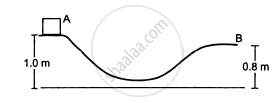
A block of mass 1 kg is placed at point A of a rough track shown in figure following. If slightly pushed towards right, it stops at point B of the track. Calculate the work done by the frictional force on the block during its transit from A to B.
A force F = 20 + 10y acts on a particle in y-direction where F is in newton and y in metre. Work done by this force to move the particle from y – 0 to y – 1 m is:
A body is being raised to a height h from the surface of earth. What is the sign of work done by applied force?
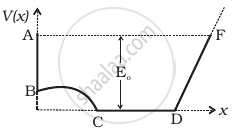
A graph of potential energy V(x) verses x is shown in figure. A particle of energy E0 is executing motion in it. Draw graph of velocity and kinetic energy versus x for one complete cycle AFA.
A cylinder of area 300 cm2 and length 10 cm made of material of specific gravity 0.8 is floated in water with its axis vertical. It is then pushed downward, so as to be just immersed. The work done by the agent who pushes the cylinder into the water is ______ J.
A body is displaced from (0, 0) to (1 m, 1 m) along the path x = y by a force F = (x2`hat"J"` + y`hat"i"`)N. The work done by this force will be:
The work done by a variable force is calculated using the formula:
When force varies non-linearly with displacement, what method must be used to find work?
