Advertisements
Advertisements
प्रश्न
A uniform chain of length L and mass M overhangs a horizontal table with its two third part on the table. The friction coefficient between the table and the chain is μ . Find the work done by friction during the period the chain slips off the table.
Advertisements
उत्तर
Let x length of the chain be on the table at a particular instant.
Consider a small element of length 'dx' and mass 'dm' on the table.
dm = \[\frac{M}{L}\text{ dx}\] Work done by the friction on this element is \[\text{ dW }= \mu \text{ Rx } = \mu \left( \frac{M}{L} \times \text{ gx } \right) \text{ dx }\]
Total work done by friction on two third part of the chain,
\[W = \int_{2L/3}^0 \mu\frac{M}{L} \text{ gx dx }\]
\[ \therefore W = \mu\frac{M}{L}\text{ g } \left[ \frac{\text{x}^2}{2} \right]_0^{2\text{L}/3} \]
\[ = - \mu\frac{M}{L}\text{g} \left[ \frac{4 L^2}{18} \right]\]
\[ = - \frac{2\mu \text{ MgL} }{9}\]
The total work done by friction during the period the chain slips off the table is \[- \frac{2\mu \text{ MgL }}{9}\]
APPEARS IN
संबंधित प्रश्न
A body constrained to move along the z-axis of a coordinate system is subject to a constant force F given by
`F = -hati+2hatj+3hatkN`
Where `hati,hatj,hatk` are unit vectors along the x-, y- and z-axis of the system respectively. What is the work done by this force in moving the body a distance of 4 m along the z-axis ?
Figure shows a cart. Complete the table shown below.
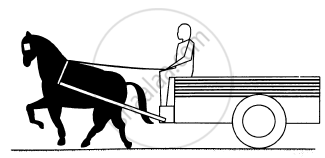
| Force on | Force by | Nature of the Force | Direction |
| Cart |
1 |
||
| Horse |
1 |
||
| Driver |
1 |
Let E, G and N represent the magnitudes of electromagnetic gravitational and nuclear forces between two electrons at a given separation. Then
The sum of all electromagnetic forces between different particles of a system of charged particles is zero
A small block of mass m is kept on a rough inclined surface of inclination θ fixed in an elevator. the elevator goes up with a uniform velocity v and the block does not slide on the wedge. The work done by the force of friction on the block in time t will be
A box is pushed through 4.0 m across a floor offering 100 N resistance. How much work is done by the resisting force?
A particle moves from a point \[\overrightarrow{r}_1 = \left( 2 m \right) \overrightarrow{ i } + \left( 3 m \right) \overrightarrow{ j } \] to another point
\[\overrightarrow{r}_2 = \left( 3 m \right) \overrightarrow{ i } + \left( 2 m \right) \overrightarrow{ j } \] acts on it. Find the work done by the force on the particle during the displacement.
A force \[F = \alpha + bx\] acts on a particle in the x-direction, where a and b are constants. Find the work done by this force during a displacement from x = 0 to x = d.
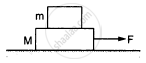
A block of mass m is kept over another block of mass M and the system rests on a horizontal surface (In the following figure). A constant horizontal force F acting on the lower block produces an acceleration \[\frac{F}{2 \left( m + M \right)}\] in the system, and the two blocks always move together. (a) Find the coefficient of kinetic friction between the bigger block and the horizontal surface. (b) Find the frictional force acting on the smaller block. (c) Find the work done by the force of friction on the smaller block by the bigger block during a displacement d of the system.
A block of weight 100 N is slowly moved up a smooth incline of inclination 37° by a person. Calculate the work done by the person in moving the block through a distance of 2 m, if the driving force is (a) parallel to the incline and (b) in the horizontal direction.
Find the average force needed to accelerate a car weighing 500 kg from rest to 72 km/h through a distance of 25 m.
A particle of mass m moves on a straight line with its velocity varying with the distance travelled, according to the equation \[\nu = a\sqrt{x}\] , where a is a constant. Find the total work done by all the forces during a displacement from \[x = 0 \text{ to } x - d\] .
A block of mass 2 kg kept at rest on an inclined plane of inclination 37° is pulled up the plane by applying a constant force of 20 N parallel to the incline. The force acts for one second. Find the kinetic energy of the block at the instant the force ceases to act. Take g = 10 m/s2.
A uniform chain of mass m and length l overhangs a table with its two third part on the table. Find the work to be done by a person to put the hanging part back on the table.
The work done by an applied variable force, F = x + x3 from x = 0 m to x = 2m, where x is displacement, is:
In the integration method for variable force, why do we divide displacement into tiny segments (ds)?
What does 'dW' represent in the variable force work calculation?
