Advertisements
Advertisements
Question
A uniform chain of length L and mass M overhangs a horizontal table with its two third part on the table. The friction coefficient between the table and the chain is μ . Find the work done by friction during the period the chain slips off the table.
Advertisements
Solution
Let x length of the chain be on the table at a particular instant.
Consider a small element of length 'dx' and mass 'dm' on the table.
dm = \[\frac{M}{L}\text{ dx}\] Work done by the friction on this element is \[\text{ dW }= \mu \text{ Rx } = \mu \left( \frac{M}{L} \times \text{ gx } \right) \text{ dx }\]
Total work done by friction on two third part of the chain,
\[W = \int_{2L/3}^0 \mu\frac{M}{L} \text{ gx dx }\]
\[ \therefore W = \mu\frac{M}{L}\text{ g } \left[ \frac{\text{x}^2}{2} \right]_0^{2\text{L}/3} \]
\[ = - \mu\frac{M}{L}\text{g} \left[ \frac{4 L^2}{18} \right]\]
\[ = - \frac{2\mu \text{ MgL} }{9}\]
The total work done by friction during the period the chain slips off the table is \[- \frac{2\mu \text{ MgL }}{9}\]
APPEARS IN
RELATED QUESTIONS
A boy is sitting on a chair placed on the floor of a room. Write as many action-reaction pairs of forces as you can.
Is it true that the reaction of a gravitational force is always gravitational, of an electromagnetic force is always electromagnetic and so on?
A 60 kg man pushes a 40 kg man by a force of 60 N. The 40 kg man has pushed the other man with a force of
A neutron exerts a force on a proton which is
(a) gravitational
(b) electromagnetic
(c) nuclear
(d) weak
Mark the correct statements :
(a) The nuclear force between two protons is always greater than the electromagnetic force between them.
(b) The electromagnetic force between two protons is always greater than the gravitational force between them.
(c) The gravitational force between two protons may be greater than the nuclear force between them.
(d) Electromagnetic force between two protons may be greater than the nuclear force acting between them.
If all matters were made of electrically neutral particles such as neutrons,
(a) there would be no force of friction
(b) there would be no tension in the string
(c) it would not be possible to sit on a chair
(d) the earth could not move around the sun.
Calculate the force with which you attract the earth.
The work done by the external forces on a system equals the change in
A block of mass 5.0 kg slides down an incline of inclination 30° and length 10 m. Find the work done by the force of gravity.
A force \[F = \alpha + bx\] acts on a particle in the x-direction, where a and b are constants. Find the work done by this force during a displacement from x = 0 to x = d.
A box weighing 2000 N is to be slowly slid through 20 m on a straight track with friction coefficient 0⋅2 with the box. (a) Find the work done by the person pulling the box with a chain at an angle θ with the horizontal. (b) Find the work when the person has chosen a value of θ, which ensures him the minimum magnitude of the force.
A block of mass 2 kg kept at rest on an inclined plane of inclination 37° is pulled up the plane by applying a constant force of 20 N parallel to the incline. The force acts for one second. Show that the work done by the applied force does not exceed 40 J.
A particle of mass m is kept on a fixed, smooth sphere of radius R at a position where the radius through the particle makes an angle of 30° with the vertical. The particle is released from this position. (a) What is the force exerted by the sphere on the particle just after the release? (b) Find the distance travelled by the particle before it loses contact with the sphere.
The work done by an applied variable force, F = x + x3 from x = 0 m to x = 2m, where x is displacement, is:
A bicyclist comes to a skidding stop in 10 m. During this process, the force on the bicycle due to the road is 200 N and is directly opposed to the motion. The work done by the cycle on the road is ______.
A body is being raised to a height h from the surface of earth. What is the sign of work done by applied force?
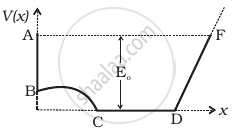
A graph of potential energy V(x) verses x is shown in figure. A particle of energy E0 is executing motion in it. Draw graph of velocity and kinetic energy versus x for one complete cycle AFA.
Work done by gas in cyclic process is ______ J.

A particle of mass 'm' and charge 'q' is placed at rest in uniform electric field E and then released. The momentum gained by the particle after moving a distance 'y' is \[\sqrt{2x}.\] Then x is equal to ______.
A particle moves under the effect of a force F = Cx from x = 0 to x = x1. The work done in the process is ______.
