Advertisements
Advertisements
प्रश्न
A uniform chain of length L and mass M overhangs a horizontal table with its two third part on the table. The friction coefficient between the table and the chain is μ . Find the work done by friction during the period the chain slips off the table.
Advertisements
उत्तर
Let x length of the chain be on the table at a particular instant.
Consider a small element of length 'dx' and mass 'dm' on the table.
dm = \[\frac{M}{L}\text{ dx}\] Work done by the friction on this element is \[\text{ dW }= \mu \text{ Rx } = \mu \left( \frac{M}{L} \times \text{ gx } \right) \text{ dx }\]
Total work done by friction on two third part of the chain,
\[W = \int_{2L/3}^0 \mu\frac{M}{L} \text{ gx dx }\]
\[ \therefore W = \mu\frac{M}{L}\text{ g } \left[ \frac{\text{x}^2}{2} \right]_0^{2\text{L}/3} \]
\[ = - \mu\frac{M}{L}\text{g} \left[ \frac{4 L^2}{18} \right]\]
\[ = - \frac{2\mu \text{ MgL} }{9}\]
The total work done by friction during the period the chain slips off the table is \[- \frac{2\mu \text{ MgL }}{9}\]
APPEARS IN
संबंधित प्रश्न
When you hold a pen and write on your notebook, what kind of force is exerted by you on the pen? By the pen on the notebook? By you on the notebook?
Is it true that the reaction of a gravitational force is always gravitational, of an electromagnetic force is always electromagnetic and so on?
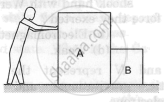
List all the forces acting on the block B in figure.
A proton exerts a force on a proton which is
(a) gravitational
(b) electromagnetic
(c) nuclear
(d) weak
A satellite is projected vertically upwards from an earth station. At what height above the earth's surface will the force on the satellite due to the earth be reduced to half its value at the earth station? (Radius of the earth is 6400 km.)
The force with which the earth attracts an object is called the weight of the object. Calculate the weight of the moon from the following data : The universal constant of gravitation G = 6.67 × 11−11 N−m2/kg2, mass of the moon = 7.36 × 10²² kg, mass of the earth = 6 × 1024 kg and the distance between the earth and the moon = 3.8 × 10⁵ km.
The average separation between the proton and the electron in a hydrogen atom in ground state is 5.3 × 10⁻¹¹ m. (a) Calculate the Coulomb force between them at this separation. (b) When the atom goes into its first excited state the average separation between the proton and the electron increases to four times its value in the ground state. What is the Coulomb force in this state?
In tug of war, the team that exerts a larger tangential force on the ground wins. Consider the period in which a team is dragging the opposite team by applying a larger tangential force on the ground. List which of the following works are positive, which are negative and which are zero?
(a) work by the winning team on the losing team
(b) work by the losing team on the winning team
(c) work by the ground on the winning team
(d) work by the ground on the losing team
(e) total external work on the two teams.
The work done by all the forces (external and internal) on a system equals the change in ______.
A particle is acted upon by a force of constant magnitude which is always perpendicular to the velocity of the plane. The motion of the particle takes place in a plane. It follows that
(a) its velocity is constant
(b) its acceleration is constant
(c) its kinetic energy is constant
(d) it moves in a circular path.
A constant force of 2⋅5 N accelerates a stationary particle of mass 15 g through a displacement of 2⋅5 m. Find the work done and the average power delivered.
A particle moves from a point \[\overrightarrow{r}_1 = \left( 2 m \right) \overrightarrow{ i } + \left( 3 m \right) \overrightarrow{ j } \] to another point
\[\overrightarrow{r}_2 = \left( 3 m \right) \overrightarrow{ i } + \left( 2 m \right) \overrightarrow{ j } \] acts on it. Find the work done by the force on the particle during the displacement.
A block of mass 250 g slides down an incline of inclination 37° with uniform speed. Find the work done against friction as the block slides through 1m.
A block of mass 2 kg kept at rest on an inclined plane of inclination 37° is pulled up the plane by applying a constant force of 20 N parallel to the incline. The force acts for one second. Find the work done by the force of gravity in that one second if the work done by the applied force is 40 J.
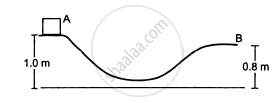
A block of mass 1 kg is placed at point A of a rough track shown in figure following. If slightly pushed towards right, it stops at point B of the track. Calculate the work done by the frictional force on the block during its transit from A to B.
A body is being raised to a height h from the surface of earth. What is the sign of work done by applied force?
A block of mass 1 kg is pushed up a surface inclined to horizontal at an angle of 30° by a force of 10 N parallel to the inclined surface (Figure). The coefficient of friction between block and the incline is 0.1. If the block is pushed up by 10 m along the incline, calulate
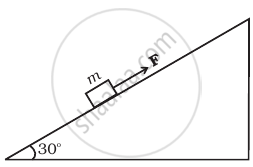
- work done against gravity
- work done against force of friction
- increase in potential energy
- increase in kinetic energy
- work done by applied force.
A body is displaced from (0, 0) to (1 m, 1 m) along the path x = y by a force F = (x2`hat"J"` + y`hat"i"`)N. The work done by this force will be:
