Advertisements
Advertisements
प्रश्न
A 250 g block slides on a rough horizontal table. Find the work done by the frictional force in bringing the block to rest if it is initially moving at a speed of 40 cm/s. If the friction coefficient between the table and the block is 0⋅1, how far does the block move before coming to rest?
Advertisements
उत्तर
\[\text{ Given } : \]
\[\text{ Mass of the block, m = 250 gm = 0 . 250 kg } \]
\[\text{ Initial speed of the block, u = 40 cm/s = 0 . 4 m/s } \]
\[\text{ Final speed of the block, }\nu = 0 \]
\[\text{ Coefficient of friction, } \mu = 0 . 1\]
Force in the forward direction is equal to the friction force.
\[\text{ Here } , \mu \text{ R = ma } \]
\[\left( \text{ where a is deceleration } \right)\]
\[a = \left( \frac{\mu R}{m} \right) = \left( \frac{\mu \text{ mg }}{m} \right) = \mu \text{ g } \]
\[ = 0 . 1 \times 9 . 8 = 0 . 98 \text{ m/ s} ^2 \]
\[s = \frac{\nu^2 - u^2}{2a} = 0 . 082 \text{ m } \]
\[ = 8 . 2 \text{ cm } \]
Again, work done against friction,
\[W = - \mu \text{ Rs } \cos \theta\]
\[ = - 1 \times 2 . 5 \times 0 . 082 \times 1\]
\[ = - 0 . 02 J\]
\[ \Rightarrow W = - 0 . 02 J\]
APPEARS IN
संबंधित प्रश्न
When you hold a pen and write on your notebook, what kind of force is exerted by you on the pen? By the pen on the notebook? By you on the notebook?
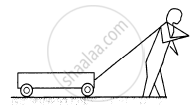
Figure shows a boy pulling a wagon on a road. List as many forces as you can which are relevant with this figure. Find the pairs of forces connected by Newton's third law of motion.
When Neils Bohr shook hand with Werner Heisenberg, what kind of force they exerted ?
The sum of all electromagnetic forces between different particles of a system of charged particles is zero
A 60 kg man pushes a 40 kg man by a force of 60 N. The 40 kg man has pushed the other man with a force of
A proton exerts a force on a proton which is
(a) gravitational
(b) electromagnetic
(c) nuclear
(d) weak
Mark the correct statements :
(a) The nuclear force between two protons is always greater than the electromagnetic force between them.
(b) The electromagnetic force between two protons is always greater than the gravitational force between them.
(c) The gravitational force between two protons may be greater than the nuclear force between them.
(d) Electromagnetic force between two protons may be greater than the nuclear force acting between them.
The gravitational force acting on a particle of 1 g due to a similar particle is equal to 6.67 × 10⁻¹⁷ N. Calculate the separation between the particles.
Calculate the force with which you attract the earth.
A monkey is sitting on a tree limb. The limb exerts a normal force of 48 N and a frictional force of 20 N. Find the magnitude of the total force exerted by the limb on the monkey.
A satellite is projected vertically upwards from an earth station. At what height above the earth's surface will the force on the satellite due to the earth be reduced to half its value at the earth station? (Radius of the earth is 6400 km.)
A particle is acted upon by a force of constant magnitude which is always perpendicular to the velocity of the plane. The motion of the particle takes place in a plane. It follows that
(a) its velocity is constant
(b) its acceleration is constant
(c) its kinetic energy is constant
(d) it moves in a circular path.
No work is done by a force on an object if
(a) the force is always perpendicular to its velocity
(b) the force is always perpendicular to its acceleration
(c) the object is stationary but the point of application of the force moves on the object
(d) the object moves in such a way that the point of application of the force remains fixed.
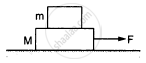
A block of mass m is kept over another block of mass M and the system rests on a horizontal surface (In the following figure). A constant horizontal force F acting on the lower block produces an acceleration \[\frac{F}{2 \left( m + M \right)}\] in the system, and the two blocks always move together. (a) Find the coefficient of kinetic friction between the bigger block and the horizontal surface. (b) Find the frictional force acting on the smaller block. (c) Find the work done by the force of friction on the smaller block by the bigger block during a displacement d of the system.
Find the average frictional force needed to stop a car weighing 500 kg at a distance of 25 m if the initial speed is 72 km/h.
A particle of mass m moves on a straight line with its velocity varying with the distance travelled, according to the equation \[\nu = a\sqrt{x}\] , where a is a constant. Find the total work done by all the forces during a displacement from \[x = 0 \text{ to } x - d\] .
A bicyclist comes to a skidding stop in 10 m. During this process, the force on the bicycle due to the road is 200 N and is directly opposed to the motion. The work done by the cycle on the road is ______.
A block of mass m is taken from A to B slowly under the action of a constant force R Work done by this force is ______.

Work done by gas in cyclic process is ______ J.

In the integration method for variable force, why do we divide displacement into tiny segments (ds)?
