Advertisements
Advertisements
प्रश्न
The force with which the earth attracts an object is called the weight of the object. Calculate the weight of the moon from the following data : The universal constant of gravitation G = 6.67 × 11−11 N−m2/kg2, mass of the moon = 7.36 × 10²² kg, mass of the earth = 6 × 1024 kg and the distance between the earth and the moon = 3.8 × 10⁵ km.
Advertisements
उत्तर
The force between the Earth and the Moon is given by \[F = \frac{GMm}{r^2}\]
Here, M is the mass of the earth; m is the mass of the moon and r is the distance between Earth and Moon.
On substituting the values, we get :
\[F = \frac{6 . 67 \times {10}^{- 11} \times 7 . 36 \times {10}^{22} \times 6 \times {10}^{24}}{3 . 8 \times 3 . 8 \times {10}^{16}}\]
\[= \frac{6 . 67 \times 7 . 36 \times {10}^{35}}{(3 . 8 )^2 \times {10}^{16}}\]
\[ = 20 . 3 \times {10}^{19} = 2 . 03 \times {10}^{20} \]
\[ \approx 2 . 0 \times {10}^{20} N\]
∴ The weight of the moon is \[2 . 0 \times {10}^{20} N\]
APPEARS IN
संबंधित प्रश्न
The sum of all electromagnetic forces between different particles of a system of charged particles is zero
A neutron exerts a force on a proton which is
(a) gravitational
(b) electromagnetic
(c) nuclear
(d) weak
At what distance should two charges, each equal to 1 C, be placed so that the force between them equals your weight ?
A monkey is sitting on a tree limb. The limb exerts a normal force of 48 N and a frictional force of 20 N. Find the magnitude of the total force exerted by the limb on the monkey.
Two charged particles placed at a separation of 20 cm exert 20 N of Coulomb force on each other. What will be the force of the separation is increased to 25 cm?
A block of mass m slides down a smooth vertical circular track. During the motion, the block is in
A box is pushed through 4.0 m across a floor offering 100 N resistance. How much work is done by the resisting force?
A block of mass 250 g slides down an incline of inclination 37° with uniform speed. Find the work done against friction as the block slides through 1m.
A block of weight 100 N is slowly moved up a smooth incline of inclination 37° by a person. Calculate the work done by the person in moving the block through a distance of 2 m, if the driving force is (a) parallel to the incline and (b) in the horizontal direction.
A block of mass 2 kg kept at rest on an inclined plane of inclination 37° is pulled up the plane by applying a constant force of 20 N parallel to the incline. The force acts for one second. Show that the work done by the applied force does not exceed 40 J.
A block of mass 2.0 kg is pushed down an inclined plane of inclination 37° with a force of 20 N acting parallel to the incline. It is found that the block moves on the incline with an acceleration of 10 m/s2. If the block started from rest, find the work done (a) by the applied force in the first second, (b) by the weight of the block in the first second and (c) by the frictional force acting on the block in the first second. Take g = 10 m/s2.
Water falling from a 50-m high fall is to be used for generating electric energy. If \[1 \cdot 8 \times {10}^5 \text{ kg } \] of water falls per hour and half the gravitational potential energy can be converted into electrical energy, how many 100 W lamps can be lit with the generated energy?
The work done by an applied variable force, F = x + x3 from x = 0 m to x = 2m, where x is displacement, is:
A lawn roller is pulled along a horizontal surface through a distance of 20 m by a rope with a force of 200 N. If the rope makes an angle of 60° with the vertical while pulling, the amount of work done by the pulling force is:
A block of mass 1 kg is pushed up a surface inclined to horizontal at an angle of 30° by a force of 10 N parallel to the inclined surface (Figure). The coefficient of friction between block and the incline is 0.1. If the block is pushed up by 10 m along the incline, calulate
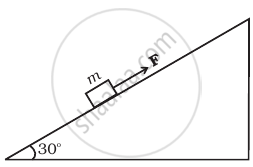
- work done against gravity
- work done against force of friction
- increase in potential energy
- increase in kinetic energy
- work done by applied force.
A body is displaced from (0, 0) to (1 m, 1 m) along the path x = y by a force F = (x2`hat"J"` + y`hat"i"`)N. The work done by this force will be:
The work done by a variable force is calculated using the formula:
A particle of mass 'm' and charge 'q' is placed at rest in uniform electric field E and then released. The momentum gained by the particle after moving a distance 'y' is \[\sqrt{2x}.\] Then x is equal to ______.
A particle moves under the effect of a force F = Cx from x = 0 to x = x1. The work done in the process is ______.
