Advertisements
Advertisements
प्रश्न
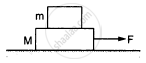
A block of mass m is kept over another block of mass M and the system rests on a horizontal surface (In the following figure). A constant horizontal force F acting on the lower block produces an acceleration \[\frac{F}{2 \left( m + M \right)}\] in the system, and the two blocks always move together. (a) Find the coefficient of kinetic friction between the bigger block and the horizontal surface. (b) Find the frictional force acting on the smaller block. (c) Find the work done by the force of friction on the smaller block by the bigger block during a displacement d of the system.
Advertisements
उत्तर
(a) \[a = \frac{F}{2 \left( M + m \right)} (\text{ given })\]
The free-body diagrams of both the blocks are shown below:

For the block of mass m,
\[\text{ ma } = \mu_1 R_1 \text{ and } R_1 = \text{ mg }\]
\[ \Rightarrow \mu_1 = \frac{\text{ma }}{R_1}\]
\[ = \frac{F}{2 \left( M + m \right) g}\]
(b)
Frictional force acting on the smaller block,
\[f_1 = \mu_1 R_1 = \frac{F}{2 \left( M + m \right) g} \times mg\]
\[ = \frac{mF}{2 (M + m)}\]
(c) Work done, w = f1s [where s = d]
\[= \frac{mF}{2 \left( M + m \right)} \times d\]
\[ = \frac{mFd}{2 \left( M + m \right)}\]
APPEARS IN
संबंधित प्रश्न
A boy is sitting on a chair placed on the floor of a room. Write as many action-reaction pairs of forces as you can.
A lawyer alleges in court that the police had forced his client to issue a statement of confession. What kind of force is this ?
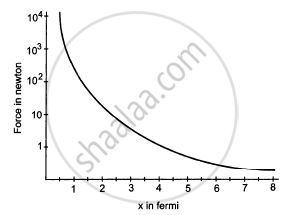
Suppose the magnitude of Nuclear force between two protons varies with the distance between them as shown in figure. Estimate the ratio "Nuclear force/Coulomb force" for
(a) x = 8 fm
(b) x = 4 fm
(c) x = 2 fm
(d) x = 1 fm (1 fm = 10 −15m).
List all the forces acting on (a) the pulley A, (b) the boy and (c) the block C in figure.
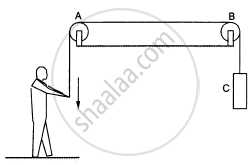
Figure shows a cart. Complete the table shown below.
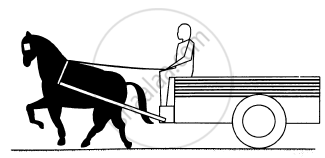
| Force on | Force by | Nature of the Force | Direction |
| Cart |
1 |
||
| Horse |
1 |
||
| Driver |
1 |
Let E, G and N represent the magnitudes of electromagnetic gravitational and nuclear forces between two electrons at a given separation. Then
A proton exerts a force on a proton which is
(a) gravitational
(b) electromagnetic
(c) nuclear
(d) weak
A satellite is projected vertically upwards from an earth station. At what height above the earth's surface will the force on the satellite due to the earth be reduced to half its value at the earth station? (Radius of the earth is 6400 km.)
The force with which the earth attracts an object is called the weight of the object. Calculate the weight of the moon from the following data : The universal constant of gravitation G = 6.67 × 11−11 N−m2/kg2, mass of the moon = 7.36 × 10²² kg, mass of the earth = 6 × 1024 kg and the distance between the earth and the moon = 3.8 × 10⁵ km.
A box is pushed through 4.0 m across a floor offering 100 N resistance. How much work is done by the resisting force?
A man moves on a straight horizontal road with a block of mass 2 kg in his hand. If he covers a distance of 40 m with an acceleration of 0⋅5 m/s2, find the work done by the man on the block during the motion.
A particle of mass m moves on a straight line with its velocity varying with the distance travelled, according to the equation \[\nu = a\sqrt{x}\] , where a is a constant. Find the total work done by all the forces during a displacement from \[x = 0 \text{ to } x - d\] .
The 200 m free-style women's swimming gold medal at Seoul Olympics in 1988 was won by Heike Friendrich of East Germany when she set a new Olympic record of 1 minute and 57⋅56 seconds. Assume that she covered most of the distance with a uniform speed and had to exert 460 W to maintain her speed. Calculate the average force of resistance offered by the water during the swim.
A block of mass 1 kg is placed at point A of a rough track shown in figure following. If slightly pushed towards right, it stops at point B of the track. Calculate the work done by the frictional force on the block during its transit from A to B.
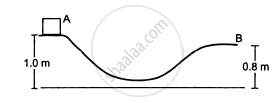
The work done by an applied variable force, F = x + x3 from x = 0 m to x = 2m, where x is displacement, is:
A body is being raised to a height h from the surface of earth. What is the sign of work done by applied force?
A block of mass 1 kg is pushed up a surface inclined to horizontal at an angle of 30° by a force of 10 N parallel to the inclined surface (Figure). The coefficient of friction between block and the incline is 0.1. If the block is pushed up by 10 m along the incline, calulate
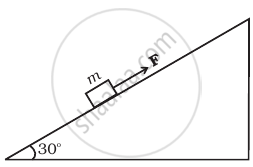
- work done against gravity
- work done against force of friction
- increase in potential energy
- increase in kinetic energy
- work done by applied force.
A body is displaced from (0, 0) to (1 m, 1 m) along the path x = y by a force F = (x2`hat"J"` + y`hat"i"`)N. The work done by this force will be:
The work done by a variable force is calculated using the formula:
A particle moves under the effect of a force F = Cx from x = 0 to x = x1. The work done in the process is ______.
