Advertisements
Advertisements
प्रश्न
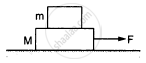
A block of mass m is kept over another block of mass M and the system rests on a horizontal surface (In the following figure). A constant horizontal force F acting on the lower block produces an acceleration \[\frac{F}{2 \left( m + M \right)}\] in the system, and the two blocks always move together. (a) Find the coefficient of kinetic friction between the bigger block and the horizontal surface. (b) Find the frictional force acting on the smaller block. (c) Find the work done by the force of friction on the smaller block by the bigger block during a displacement d of the system.
Advertisements
उत्तर
(a) \[a = \frac{F}{2 \left( M + m \right)} (\text{ given })\]
The free-body diagrams of both the blocks are shown below:

For the block of mass m,
\[\text{ ma } = \mu_1 R_1 \text{ and } R_1 = \text{ mg }\]
\[ \Rightarrow \mu_1 = \frac{\text{ma }}{R_1}\]
\[ = \frac{F}{2 \left( M + m \right) g}\]
(b)
Frictional force acting on the smaller block,
\[f_1 = \mu_1 R_1 = \frac{F}{2 \left( M + m \right) g} \times mg\]
\[ = \frac{mF}{2 (M + m)}\]
(c) Work done, w = f1s [where s = d]
\[= \frac{mF}{2 \left( M + m \right)} \times d\]
\[ = \frac{mFd}{2 \left( M + m \right)}\]
APPEARS IN
संबंधित प्रश्न
A lawyer alleges in court that the police had forced his client to issue a statement of confession. What kind of force is this ?
When you hold a pen and write on your notebook, what kind of force is exerted by you on the pen? By the pen on the notebook? By you on the notebook?
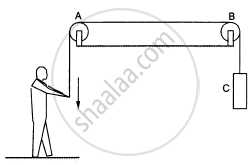
List all the forces acting on (a) the pulley A, (b) the boy and (c) the block C in figure.
Let E, G and N represent the magnitudes of electromagnetic gravitational and nuclear forces between two electrons at a given separation. Then
The sum of all electromagnetic forces between different particles of a system of charged particles is zero
Calculate the force with which you attract the earth.
Two spherical bodies, each of mass 50 kg, are placed at a separation of 20 cm. Equal charges are placed on the bodies and it is found that the force of Coulomb repulsion equals the gravitational attraction in magnitude. Find the magnitude of the charge placed on either body.
Find the ratio of the magnitude of the electric force to the gravitational force acting between two protons.
The work done by all the forces (external and internal) on a system equals the change in ______.
A block of mass m slides down a smooth vertical circular track. During the motion, the block is in
A box is pushed through 4.0 m across a floor offering 100 N resistance. How much work is done by the resisting force?
A block of weight 100 N is slowly moved up a smooth incline of inclination 37° by a person. Calculate the work done by the person in moving the block through a distance of 2 m, if the driving force is (a) parallel to the incline and (b) in the horizontal direction.
A block of mass 2 kg kept at rest on an inclined plane of inclination 37° is pulled up the plane by applying a constant force of 20 N parallel to the incline. The force acts for one second. Find the work done by the force of gravity in that one second if the work done by the applied force is 40 J.
A 250 g block slides on a rough horizontal table. Find the work done by the frictional force in bringing the block to rest if it is initially moving at a speed of 40 cm/s. If the friction coefficient between the table and the block is 0⋅1, how far does the block move before coming to rest?
A body is moving unidirectionally under the influence of a source of constant power supplying energy. Which of the diagrams shown in figure correctly shows the displacement-time curve for its motion?
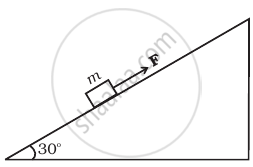
A block of mass 1 kg is pushed up a surface inclined to horizontal at an angle of 30° by a force of 10 N parallel to the inclined surface (Figure). The coefficient of friction between block and the incline is 0.1. If the block is pushed up by 10 m along the incline, calulate
- work done against gravity
- work done against force of friction
- increase in potential energy
- increase in kinetic energy
- work done by applied force.
Force acting on a particle is (2`hat"i"` + 3 `hat"j"`) N. Work done by this force is zero, when a particle is moved on the line 3y + kx = 5. Here value of k is ______.
When force varies non-linearly with displacement, what method must be used to find work?
A particle of mass 'm' and charge 'q' is placed at rest in uniform electric field E and then released. The momentum gained by the particle after moving a distance 'y' is \[\sqrt{2x}.\] Then x is equal to ______.
