Advertisements
Advertisements
प्रश्न
The gravitational force acting on a particle of 1 g due to a similar particle is equal to 6.67 × 10⁻¹⁷ N. Calculate the separation between the particles.
Advertisements
उत्तर
Mass of the particle, m = 1 gm \[= \frac{1}{1000} kg\]
Let the distance between the two particles be r.
Gravitational force between the particle, F = 6.67 × 10⁻¹⁷ N
Also, \[F = \frac{\text{ G m} _1 \text{ m }_2}{r^2}\]
Substituting the respective values in the above formula, we get :
\[6 . 67 \times {10}^{- 17} = \frac{6 . 67 \times {10}^{- 11} \times \left( 1/1000 \right) \times \left( 1/1000 \right)}{r^2}\]
\[ \Rightarrow r^2 = \frac{6 . 67 \times {10}^{- 6} \times {10}^{- 11}}{6 . 67 \times {10}^{- 17}}\]
\[ = \frac{{10}^{- 17}}{{10}^{- 17}} = 1\]
\[ \Rightarrow r = \sqrt{1} = 1 \text{ m }\]
∴ The separation between the particles is 1 m.
APPEARS IN
संबंधित प्रश्न
The sum of all electromagnetic forces between different particles of a system of charged particles is zero
In tug of war, the team that exerts a larger tangential force on the ground wins. Consider the period in which a team is dragging the opposite team by applying a larger tangential force on the ground. List which of the following works are positive, which are negative and which are zero?
(a) work by the winning team on the losing team
(b) work by the losing team on the winning team
(c) work by the ground on the winning team
(d) work by the ground on the losing team
(e) total external work on the two teams.
The magnetic force on a charged particle is always perpendicular to its velocity. Can the magnetic force change the velocity of the particles? Speed of the particle?
The work done by all the forces (external and internal) on a system equals the change in ______.
A box is pushed through 4.0 m across a floor offering 100 N resistance. How much work is done by the resisting force?
A particle moves from a point \[\overrightarrow{r}_1 = \left( 2 m \right) \overrightarrow{ i } + \left( 3 m \right) \overrightarrow{ j } \] to another point
\[\overrightarrow{r}_2 = \left( 3 m \right) \overrightarrow{ i } + \left( 2 m \right) \overrightarrow{ j } \] acts on it. Find the work done by the force on the particle during the displacement.
A block of weight 100 N is slowly moved up a smooth incline of inclination 37° by a person. Calculate the work done by the person in moving the block through a distance of 2 m, if the driving force is (a) parallel to the incline and (b) in the horizontal direction.
A block of mass 2 kg kept at rest on an inclined plane of inclination 37° is pulled up the plane by applying a constant force of 20 N parallel to the incline. The force acts for one second. Find the kinetic energy of the block at the instant the force ceases to act. Take g = 10 m/s2.
A force F = 20 + 10y acts on a particle in y-direction where F is in newton and y in metre. Work done by this force to move the particle from y – 0 to y – 1 m is:
The work done by an applied variable force, F = x + x3 from x = 0 m to x = 2m, where x is displacement, is:
A lawn roller is pulled along a horizontal surface through a distance of 20 m by a rope with a force of 200 N. If the rope makes an angle of 60° with the vertical while pulling, the amount of work done by the pulling force is:
A bicyclist comes to a skidding stop in 10 m. During this process, the force on the bicycle due to the road is 200 N and is directly opposed to the motion. The work done by the cycle on the road is ______.
A body is being raised to a height h from the surface of earth. What is the sign of work done by applied force?
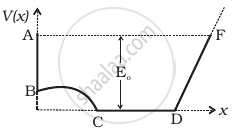
A graph of potential energy V(x) verses x is shown in figure. A particle of energy E0 is executing motion in it. Draw graph of velocity and kinetic energy versus x for one complete cycle AFA.
In the integration method for variable force, why do we divide displacement into tiny segments (ds)?
If a force varies linearly with displacement, the area under the F-s graph forms:
What does 'dW' represent in the variable force work calculation?
When force varies non-linearly with displacement, what method must be used to find work?
