Advertisements
Advertisements
प्रश्न
A boy is sitting on a chair placed on the floor of a room. Write as many action-reaction pairs of forces as you can.
Advertisements
उत्तर
The given situation involves two action-reaction pairs of forces. They are :
(a) The action force (F = mg) with which the boy pushes the chair in the downward direction and the reaction force (F' =\[-\]mg) with which the chair exerts on the boy in the upward direction.
(b) The action force (F = (M + m)g) with which the boy and the chair push the ground in the downward direction and the reaction force (F' = (M + m)g) with which the ground exerts on the boy and the chair in the upward direction.
APPEARS IN
संबंधित प्रश्न
When you hold a pen and write on your notebook, what kind of force is exerted by you on the pen? By the pen on the notebook? By you on the notebook?
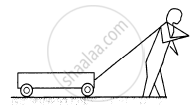
Figure shows a boy pulling a wagon on a road. List as many forces as you can which are relevant with this figure. Find the pairs of forces connected by Newton's third law of motion.
When Neils Bohr shook hand with Werner Heisenberg, what kind of force they exerted ?
The sum of all electromagnetic forces between different particles of a system of charged particles is zero
At what distance should two charges, each equal to 1 C, be placed so that the force between them equals your weight ?
Two spherical bodies, each of mass 50 kg, are placed at a separation of 20 cm. Equal charges are placed on the bodies and it is found that the force of Coulomb repulsion equals the gravitational attraction in magnitude. Find the magnitude of the charge placed on either body.
Two charged particles placed at a separation of 20 cm exert 20 N of Coulomb force on each other. What will be the force of the separation is increased to 25 cm?
In tug of war, the team that exerts a larger tangential force on the ground wins. Consider the period in which a team is dragging the opposite team by applying a larger tangential force on the ground. List which of the following works are positive, which are negative and which are zero?
(a) work by the winning team on the losing team
(b) work by the losing team on the winning team
(c) work by the ground on the winning team
(d) work by the ground on the losing team
(e) total external work on the two teams.
A small block of mass m is kept on a rough inclined surface of inclination θ fixed in an elevator. the elevator goes up with a uniform velocity v and the block does not slide on the wedge. The work done by the force of friction on the block in time t will be
A box is pushed through 4.0 m across a floor offering 100 N resistance. How much work is done by the resisting force?
A force \[F = \alpha + bx\] acts on a particle in the x-direction, where a and b are constants. Find the work done by this force during a displacement from x = 0 to x = d.
Find the average force needed to accelerate a car weighing 500 kg from rest to 72 km/h through a distance of 25 m.
The 200 m free-style women's swimming gold medal at Seoul Olympics in 1988 was won by Heike Friendrich of East Germany when she set a new Olympic record of 1 minute and 57⋅56 seconds. Assume that she covered most of the distance with a uniform speed and had to exert 460 W to maintain her speed. Calculate the average force of resistance offered by the water during the swim.
A particle of mass m is kept on a fixed, smooth sphere of radius R at a position where the radius through the particle makes an angle of 30° with the vertical. The particle is released from this position. (a) What is the force exerted by the sphere on the particle just after the release? (b) Find the distance travelled by the particle before it loses contact with the sphere.
A lawn roller is pulled along a horizontal surface through a distance of 20 m by a rope with a force of 200 N. If the rope makes an angle of 60° with the vertical while pulling, the amount of work done by the pulling force is:
A body of mass 0.5 kg travels in a straight line with velocity v = a x3/2 where a = 5 m–1/2s–1. The work done by the net force during its displacement from x = 0 to x = 2 m is ______.
A body is being raised to a height h from the surface of earth. What is the sign of work done by gravitational force?
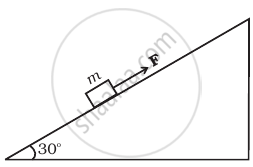
A block of mass 1 kg is pushed up a surface inclined to horizontal at an angle of 30° by a force of 10 N parallel to the inclined surface (Figure). The coefficient of friction between block and the incline is 0.1. If the block is pushed up by 10 m along the incline, calulate
- work done against gravity
- work done against force of friction
- increase in potential energy
- increase in kinetic energy
- work done by applied force.
A block of mass m is taken from A to B slowly under the action of a constant force R Work done by this force is ______.

A cylinder of area 300 cm2 and length 10 cm made of material of specific gravity 0.8 is floated in water with its axis vertical. It is then pushed downward, so as to be just immersed. The work done by the agent who pushes the cylinder into the water is ______ J.
