Advertisements
Advertisements
प्रश्न
The 200 m free-style women's swimming gold medal at Seoul Olympics in 1988 was won by Heike Friendrich of East Germany when she set a new Olympic record of 1 minute and 57⋅56 seconds. Assume that she covered most of the distance with a uniform speed and had to exert 460 W to maintain her speed. Calculate the average force of resistance offered by the water during the swim.
Advertisements
उत्तर
\[\text{ Time taken to cover 200 m, t } = 1 \min 57 . 56 \text{ seconds = 117 . 56 s } \]
\[\text{ Power exerted by her, } \]
\[\text{ P = 460 W } \]
\[P = \frac{W}{t}\]
\[\text{ Work done, W = Pt } = 460 \times 117 . 56 J\]
\[\text{ Again, W = Fs } \]
\[ \Rightarrow F = \frac{W}{s}\]
\[ = \frac{460 \times 117 . 56}{200}\]
\[ = 270 . 3 \text{ N } \approx 270 \text{ N } \]
∴ Resistance force offered by the water during the swim is 270 N.
APPEARS IN
संबंधित प्रश्न
A body of mass m is placed on a table. The earth is pulling the body with a force mg. Taking this force to be the action what is the reaction?
A boy is sitting on a chair placed on the floor of a room. Write as many action-reaction pairs of forces as you can.
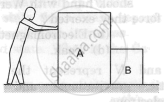
List all the forces acting on the block B in figure.
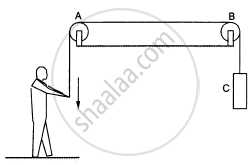
List all the forces acting on (a) the pulley A, (b) the boy and (c) the block C in figure.
A neutron exerts a force on a proton which is
(a) gravitational
(b) electromagnetic
(c) nuclear
(d) weak
A monkey is sitting on a tree limb. The limb exerts a normal force of 48 N and a frictional force of 20 N. Find the magnitude of the total force exerted by the limb on the monkey.
A body builder exerts a force of 150 N against a bullworker and compresses it by 20 cm. Calculate the spring constant of the spring in the bullworker.
A block of mass m slides down a smooth vertical circular track. During the motion, the block is in
A particle moves from a point \[\overrightarrow{r}_1 = \left( 2 m \right) \overrightarrow{ i } + \left( 3 m \right) \overrightarrow{ j } \] to another point
\[\overrightarrow{r}_2 = \left( 3 m \right) \overrightarrow{ i } + \left( 2 m \right) \overrightarrow{ j } \] acts on it. Find the work done by the force on the particle during the displacement.
A man moves on a straight horizontal road with a block of mass 2 kg in his hand. If he covers a distance of 40 m with an acceleration of 0⋅5 m/s2, find the work done by the man on the block during the motion.
Find the average force needed to accelerate a car weighing 500 kg from rest to 72 km/h through a distance of 25 m.
Water falling from a 50-m high fall is to be used for generating electric energy. If \[1 \cdot 8 \times {10}^5 \text{ kg } \] of water falls per hour and half the gravitational potential energy can be converted into electrical energy, how many 100 W lamps can be lit with the generated energy?
A body of mass 0.5 kg travels in a straight line with velocity v = a x3/2 where a = 5 m–1/2s–1. The work done by the net force during its displacement from x = 0 to x = 2 m is ______.
A body is moving unidirectionally under the influence of a source of constant power supplying energy. Which of the diagrams shown in figure correctly shows the displacement-time curve for its motion?
A body is being raised to a height h from the surface of earth. What is the sign of work done by gravitational force?
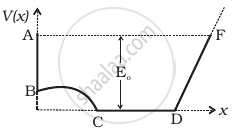
A graph of potential energy V(x) verses x is shown in figure. A particle of energy E0 is executing motion in it. Draw graph of velocity and kinetic energy versus x for one complete cycle AFA.
When force varies non-linearly with displacement, what method must be used to find work?
A particle moves under the effect of a force F = Cx from x = 0 to x = x1. The work done in the process is ______.
