Advertisements
Advertisements
Question
The average separation between the proton and the electron in a hydrogen atom in ground state is 5.3 × 10⁻¹¹ m. (a) Calculate the Coulomb force between them at this separation. (b) When the atom goes into its first excited state the average separation between the proton and the electron increases to four times its value in the ground state. What is the Coulomb force in this state?
Advertisements
Solution
Average separation between the proton and the electron of a Hydrogen atom in ground state, r = 5.3 × 10⁻¹¹ m
(a) Coulomb force when the proton and the electron in a hydrogen atom in ground state
\[F = 9 \times {10}^9 \times \frac{q_1 q_2}{r_2}\]
\[ = \frac{9 \times {10}^9 \times \left( 1 . 6 \times {10}^{- 19} \right)^2}{\left( 5 . 3 \times {10}^{- 11} \right)^2} = 8 . 2 \times {10}^{- 8} \text{N}\]
(b) Coulomb force when the average distance between the proton and the electron becomes 4 times that of its ground state
\[\text {Coulomb force, F } = \frac{1}{4\pi \in_0} = \frac{q_1 q_2}{\left( 4r \right)^2}\]
\[ = \frac{9 \times {10}^9 \times \left( 1 . 6 \times {10}^{- 19} \right)^2}{16 \times \left( 5 . 3 \right)^2 \times {10}^{- 22}}\]
\[ = \frac{9 \times \left( 1 . 6 \right)^2}{10 \times \left( 5 . 3 \right)^2} \times {10}^{- 7} \]
\[ = 0 . 0512 \times {10}^{- 7} \]
\[ = 5 . 1 \times {10}^{- 9} \text{ N }\]
APPEARS IN
RELATED QUESTIONS
State if the following statement is true or false. Give a reason for your answer.
Work done in the motion of a body over a closed loop is zero for every force in nature.
A body constrained to move along the z-axis of a coordinate system is subject to a constant force F given by
`F = -hati+2hatj+3hatkN`
Where `hati,hatj,hatk` are unit vectors along the x-, y- and z-axis of the system respectively. What is the work done by this force in moving the body a distance of 4 m along the z-axis ?
When you hold a pen and write on your notebook, what kind of force is exerted by you on the pen? By the pen on the notebook? By you on the notebook?
Is it true that the reaction of a gravitational force is always gravitational, of an electromagnetic force is always electromagnetic and so on?
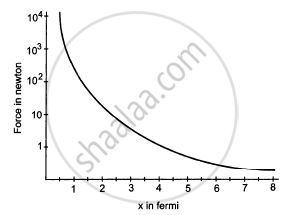
Suppose the magnitude of Nuclear force between two protons varies with the distance between them as shown in figure. Estimate the ratio "Nuclear force/Coulomb force" for
(a) x = 8 fm
(b) x = 4 fm
(c) x = 2 fm
(d) x = 1 fm (1 fm = 10 −15m).
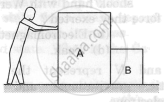
List all the forces acting on the block B in figure.
A proton exerts a force on a proton which is
(a) gravitational
(b) electromagnetic
(c) nuclear
(d) weak
Calculate the force with which you attract the earth.
Two spherical bodies, each of mass 50 kg, are placed at a separation of 20 cm. Equal charges are placed on the bodies and it is found that the force of Coulomb repulsion equals the gravitational attraction in magnitude. Find the magnitude of the charge placed on either body.
A block of mass m slides down a smooth vertical circular track. During the motion, the block is in
A force \[F = \alpha + bx\] acts on a particle in the x-direction, where a and b are constants. Find the work done by this force during a displacement from x = 0 to x = d.
A box weighing 2000 N is to be slowly slid through 20 m on a straight track with friction coefficient 0⋅2 with the box. (a) Find the work done by the person pulling the box with a chain at an angle θ with the horizontal. (b) Find the work when the person has chosen a value of θ, which ensures him the minimum magnitude of the force.
A block of mass 2 kg kept at rest on an inclined plane of inclination 37° is pulled up the plane by applying a constant force of 20 N parallel to the incline. The force acts for one second. Find the work done by the force of gravity in that one second if the work done by the applied force is 40 J.
A block of mass 2.0 kg is pushed down an inclined plane of inclination 37° with a force of 20 N acting parallel to the incline. It is found that the block moves on the incline with an acceleration of 10 m/s2. If the block started from rest, find the work done (a) by the applied force in the first second, (b) by the weight of the block in the first second and (c) by the frictional force acting on the block in the first second. Take g = 10 m/s2.
Water falling from a 50-m high fall is to be used for generating electric energy. If \[1 \cdot 8 \times {10}^5 \text{ kg } \] of water falls per hour and half the gravitational potential energy can be converted into electrical energy, how many 100 W lamps can be lit with the generated energy?
A uniform chain of length L and mass M overhangs a horizontal table with its two third part on the table. The friction coefficient between the table and the chain is μ . Find the work done by friction during the period the chain slips off the table.
A body is moving unidirectionally under the influence of a source of constant power supplying energy. Which of the diagrams shown in figure correctly shows the displacement-time curve for its motion?
A body is being raised to a height h from the surface of earth. What is the sign of work done by applied force?
A body is being raised to a height h from the surface of earth. What is the sign of work done by gravitational force?
A particle of mass 'm' and charge 'q' is placed at rest in uniform electric field E and then released. The momentum gained by the particle after moving a distance 'y' is \[\sqrt{2x}.\] Then x is equal to ______.
