Advertisements
Advertisements
Question
The work done by all the forces (external and internal) on a system equals the change in ______.
Options
total energy
kinetic energy
potential energy
none of these
Advertisements
Solution
The work done by all the forces (external and internal) on a system equals the change in kinetic energy.
Explanation:
As we know that the work done by the external force changes into the total energy but the internal force acting in the object can only vibrate the molecules or the atoms which further leads to the movement as the result of which Kinetic energy also increases.
Thus, the work done by all the forces (External or Internal) will completely lead to increases in the kinetic energy.
RELATED QUESTIONS
A boy is sitting on a chair placed on the floor of a room. Write as many action-reaction pairs of forces as you can.
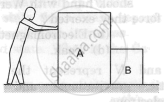
List all the forces acting on the block B in figure.
The sum of all electromagnetic forces between different particles of a system of charged particles is zero
A neutron exerts a force on a proton which is
(a) gravitational
(b) electromagnetic
(c) nuclear
(d) weak
The gravitational force acting on a particle of 1 g due to a similar particle is equal to 6.67 × 10⁻¹⁷ N. Calculate the separation between the particles.
Find the ratio of the magnitude of the electric force to the gravitational force acting between two protons.
The average separation between the proton and the electron in a hydrogen atom in ground state is 5.3 × 10⁻¹¹ m. (a) Calculate the Coulomb force between them at this separation. (b) When the atom goes into its first excited state the average separation between the proton and the electron increases to four times its value in the ground state. What is the Coulomb force in this state?
The work done by the external forces on a system equals the change in
A small block of mass m is kept on a rough inclined surface of inclination θ fixed in an elevator. the elevator goes up with a uniform velocity v and the block does not slide on the wedge. The work done by the force of friction on the block in time t will be
A force \[F = \alpha + bx\] acts on a particle in the x-direction, where a and b are constants. Find the work done by this force during a displacement from x = 0 to x = d.
A block of weight 100 N is slowly moved up a smooth incline of inclination 37° by a person. Calculate the work done by the person in moving the block through a distance of 2 m, if the driving force is (a) parallel to the incline and (b) in the horizontal direction.
Find the average frictional force needed to stop a car weighing 500 kg at a distance of 25 m if the initial speed is 72 km/h.
A uniform chain of mass m and length l overhangs a table with its two third part on the table. Find the work to be done by a person to put the hanging part back on the table.
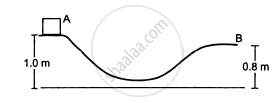
A block of mass 1 kg is placed at point A of a rough track shown in figure following. If slightly pushed towards right, it stops at point B of the track. Calculate the work done by the frictional force on the block during its transit from A to B.
A force F = 20 + 10y acts on a particle in y-direction where F is in newton and y in metre. Work done by this force to move the particle from y – 0 to y – 1 m is:
A body is being raised to a height h from the surface of earth. What is the sign of work done by applied force?
Work done by gas in cyclic process is ______ J.

In the integration method for variable force, why do we divide displacement into tiny segments (ds)?
