Advertisements
Advertisements
Question
Trace a ray of light incident at 30° on a surface if travelling from glass to air. What is the angle of refraction in this case? (R.I. for glass = 3/2).
Advertisements
Solution
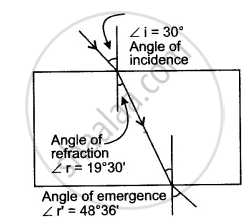
For a ray of light from glass to air R.I. is denoted as gμa.
`""_"g"mu_"a"=1/(""_"a"mu_"g")`
∴ `sin"i"/sin"r′"=1/(""_"a"mu_"g")`
sin r′ = aμg × sin i
and aμg = `3/2`
∴ sin r′ = `3/2xx1/2`
= `3/4`
= 0.7500
∴ r′ = 48°36′
Angle of refraction for glass to air = 48°36′.
RELATED QUESTIONS
Explain how spectrum is formed.
Select from the following the best experimental setup for tracing the path of a ray of light passing through a rectangular glass slab.
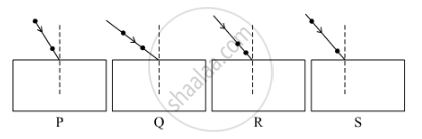
(a) P
(b) Q
(c) R
(d) S
State the dependence of angle of deviation On the refractive index of the material of the prism.
With the help of diagram of the principal section of a prism, indicate its refracting surfaces, refracting edge and base.
A ray of light enters a glass slab ABDC as shown in figure and strikes at the centre O of the circular part AC of the slab. The critical angle of glass is 42°. Complete the path of the ray till it emerges out from the slab. Mark the angles in the diagram wherever necessary.
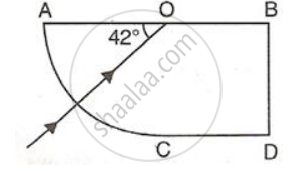
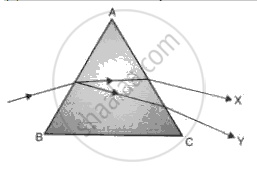
Fig. shows a ray of white light that passes through a prism and produces a spectrum.
(a) Name the phenomenon that is taking place.
(b) What colour would you see at X and Y?
(c) What radiation would you detect above X and below Y?
State the factors on which the angle of deviation depends.
Why does the sun appear bigger during sunset or sunrise?
Explain with the help of a diagram of how fish is able to see the objects above it.
