Advertisements
Advertisements
Question
Three vertices of a parallelogram ABCD are A (3, –1, 2), B (1, 2, –4) and C (–1, 1, 2). Find the coordinates of the fourth vertex.
Advertisements
Solution
Vertices A and C are (3, –1, 2), (−1, 1, 2) respectively.
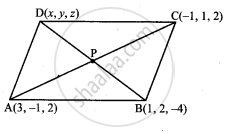
Coordinates of the midpoint P between A and C `((3 - 1)/2, (-1 + 1)/2, (2 + 2)/2)` = (1, 0, 2)
Let the coordinates of point D be (x, y, z) and the coordinates of point B be (1, 2, −4).
∴ Mid point of DB `(("x" + 1)/2, ("y" + 2)/2, ("z" - 4)/2)`
The diagonals of a parallelogram divide each other into 2 equal parts.
Therefore, `("x" + 1)/2 = 1, ("y" + 2)/2 = 0, ("z" - 4)/2 = 2`
Hence, the coordinates of point D are (1, –2, 8).
APPEARS IN
RELATED QUESTIONS
The x-axis and y-axis taken together determine a plane known as_______.
Find the image of:
(–2, 3, 4) in the yz-plane.
Find the image of:
(–4, 0, 0) in the xy-plane.
Planes are drawn through the points (5, 0, 2) and (3, –2, 5) parallel to the coordinate planes. Find the lengths of the edges of the rectangular parallelepiped so formed.
Find the distances of the point P(–4, 3, 5) from the coordinate axes.
Find the point on y-axis which is equidistant from the points (3, 1, 2) and (5, 5, 2).
Prove that the point A(1, 3, 0), B(–5, 5, 2), C(–9, –1, 2) and D(–3, –3, 0) taken in order are the vertices of a parallelogram. Also, show that ABCD is not a rectangle.
Find the coordinates of the point which is equidistant from the four points O(0, 0, 0), A(2, 0, 0), B(0, 3, 0) and C(0, 0, 8).
If A(–2, 2, 3) and B(13, –3, 13) are two points.
Find the locus of a point P which moves in such a way the 3PA = 2PB.
Verify the following:
(0, 7, –10), (1, 6, –6) and (4, 9, –6) are vertices of an isosceles triangle.
Verify the following:
(0, 7, 10), (–1, 6, 6) and (–4, 9, –6) are vertices of a right-angled triangle.
Verify the following:
(5, –1, 1), (7, –4,7), (1, –6,10) and (–1, – 3,4) are the vertices of a rhombus.
Write the distance of the point P (2, 3,5) from the xy-plane.
The ratio in which the line joining the points (a, b, c) and (–a, –c, –b) is divided by the xy-plane is
The coordinates of the foot of the perpendicular drawn from the point P(3, 4, 5) on the yz- plane are
The perpendicular distance of the point P(3, 3,4) from the x-axis is
The length of the perpendicular drawn from the point P(a, b, c) from z-axis is
Find the coordinates of the point where the line through (3, – 4, – 5) and (2, –3, 1) crosses the plane passing through three points (2, 2, 1), (3, 0, 1) and (4, –1, 0)
A plane meets the co-ordinates axis in A, B, C such that the centroid of the ∆ABC is the point (α, β, γ). Show that the equation of the plane is `x/alpha + y/beta + z/γ` = 3
Find the co-ordinates of the foot of perpendicular drawn from the point A(1, 8, 4) to the line joining the points B(0, –1, 3) and C(2, –3, –1).
Find the image of the point having position vector `hati + 3hatj + 4hatk` in the plane `hatr * (2hati - hatj + hatk)` + 3 = 0.
Prove that the lines x = py + q, z = ry + s and x = p′y + q′, z = r′y + s′ are perpendicular if pp′ + rr′ + 1 = 0.
Find the equation of the plane through the points (2, 1, 0), (3, –2, –2) and (3, 1, 7).
If a variable line in two adjacent positions has direction cosines l, m, n and l + δl, m + δm, n + δn, show that the small angle δθ between the two positions is given by δθ2 = δl2 + δm2 + δn2
Find the equation of the plane which is perpendicular to the plane 5x + 3y + 6z + 8 = 0 and which contains the line of intersection of the planes x + 2y + 3z – 4 = 0 and 2x + y – z + 5 = 0.
If l1, m1, n1 ; l2, m2, n2 ; l3, m3, n3 are the direction cosines of three mutually perpendicular lines, prove that the line whose direction cosines are proportional to l1 + l2 + l3, m1 + m2 + m3, n1 + n2 + n3 makes equal angles with them.
The plane 2x – 3y + 6z – 11 = 0 makes an angle sin–1(α) with x-axis. The value of α is equal to ______.
The direction cosines of the vector `(2hati + 2hatj - hatk)` are ______.
The vector equation of the line through the points (3, 4, –7) and (1, –1, 6) is ______.
The unit vector normal to the plane x + 2y +3z – 6 = 0 is `1/sqrt(14)hati + 2/sqrt(14)hatj + 3/sqrt(14)hatk`.
The intercepts made by the plane 2x – 3y + 5z +4 = 0 on the co-ordinate axis are `-2, 4/3, - 4/5`.
The vector equation of the line `(x - 5)/3 = (y + 4)/7 = (z - 6)/2` is `vecr = (5hati - 4hatj + 6hatk) + lambda(3hati + 7hatj - 2hatk)`.
