Advertisements
Advertisements
Question
The sides of a triangle are 21 cm, 17 cm, and 10 cm. Find its area.
Advertisements
Solution
Let a = 21 cm, b = 17 cm and c = 10 cm
∴ a + b + c
= 21 cm + 17 cm + 10 cm = 48 cm
s =`"a + b + c"/2=48/2` = 24 cm
Area of the triangle
= `sqrt(s(s-a)(s-b)(s-c))`
= `sqrt(24(24-21)(24-17)(24-10))`
= `sqrt(24xx3xx7xx14)`
= `sqrt(2xx2xx2xx3xx3xx7xx2xx7)`
= 2 × 2 × 3 × 7
= 84 cm2
APPEARS IN
RELATED QUESTIONS
In the figure given below, find the area of shaded region: (All measurements are in cm)
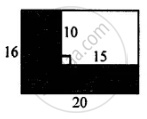
In the figure given below, find the area of shaded region: (All measurements are in cm)
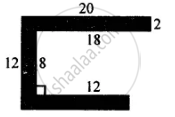
Find the area of the rhombus, if its diagonals are 30 cm and 24 cm.
Find the area of a triangle whose base is 30 cm and the height is 18 cm.
The area of a right-angled triangle is 160 cm2. If its one leg is 16 cm long, find the length of the other leg.
The diameter of a circle is 20 cm. Taking π = 3.14, find the circumference and its area.
The ratio between the areas of two circles is 16 : 9. Find the ratio between their :
(i) radius
(ii) diameters
(iii) circumference
A metal wire, when bent in the form of a square of largest area, encloses an area of 484 cm2. Find the length of the wire. If the same wire is bent to the largest circle, find:
(i) radius of the circle formed.
(ii) area of the circle.
A wire is along the boundary of a circle with a radius of 28 cm. If the same wire is bent in the form of a square, find the area of the square formed.
The length and breadth of a rectangular paper are 35 cm and 22 cm. Find the area of the largest circle which can be cut out of this paper.
