Advertisements
Advertisements
Question
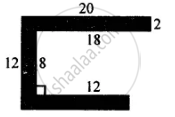
In the figure given below, find the area of shaded region: (All measurements are in cm)
Advertisements
Solution
The shaded region is a uniform-width frame (thickness 2 cm) around an inner 18 × 8 rectangle.
From the diagram:
-
Outer top length = 20 cm
-
Inner top length = 18 cm
So frame thickness =
`(20-18)/2` = 1 cm on each side
`(12-8)/2` = 2 cm thickness
Step 1: Outer Rectangle Area
Width = 18 + 2 + 2 = 22 cm
Height = 8 + 2 + 2 = 12 cm
Outer Area = 22 × 12
= 264 cm2
Step 2: Inner Rectangle Area
Inner Area = 18 × 8
= 144 cm2
Step 3: Shaded Area = Outer – Inner
Shaded Area = 264 − 144
= 120 cm2
But the shaded region is not the full frame, the bottom bar extends only 12 cm, not the full 22 cm width.
Missing bottom area:
Missing length = 22 − 12 = 10 cm
Frame thickness = 2 cm
Missing area = 10 × 2 = 20 cm2
120 − 20 = 100 cm2
Let’s incorporate the right side, which is only 2 cm tall, not full height.
Height missing = 12 − 2 = 10 cm
Thickness = 2 cm
Missing right area = 10 × 2 = 20 cm2
Now total missing area:
20 + 20 = 40 cm2
120 − 40 = 80 cm2
Missing bottom area:
6 × 2 = 12 cm2
Right missing:
(12 − 2) × 2 = 20
Total missing = 12 + 20 = 32
Correct shaded:
120 − 32 = 88
Top bar: 20 × 2 = 40
Left bar: 12 × 2 = 24
Bottom bar: 12 × 2 = 24
Total shaded: 40 + 24 + 24 = 88
APPEARS IN
RELATED QUESTIONS
Find the area of the square whose perimeter is 56 cm.
A square lawn is surrounded by a path 2.5 m wide. If the area of the path is 165 m2 find the area of the lawn.
In the figure given below, find the area of shaded region: (All measurements are in cm)
The area of a rhombus is 84 cm2 and its perimeter is 56 cm. Find its height.
Find the area of a triangle whose base is 30 cm and the height is 18 cm.
The area of a right-angled triangle is 160 cm2. If its one leg is 16 cm long, find the length of the other leg.
Find the area of an isosceles triangle whose base is 16 cm and the length of each of the equal sides is 10 cm.
The legs of a right-angled triangle are in the ratio 4 : 3 and its area is 4056 cm2. Find the length of its legs.
The sides of a triangle are in the ratio 15 : 13 : 14 and its perimeter is 168 cm. Find the area of the triangle.
The diameter of the wheel of a car is 70 cm. How many revolutions will it make to travel one kilometer?
