Advertisements
Advertisements
Question
The adjacent sides of a parallelogram are 15 cm and 10 cm. If the distance between the longer sides is 6 cm, find the distance between the shorter sides.
Advertisements
Solution
In parallelogram ABCD
AB = DC = 15 cm
BC = AD = 10 cm
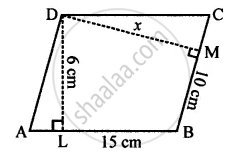
Distance between longer sides AB and DC is 6 cm
i.e., perpendicular DL = 6 cm
DM ⊥ BC
Area of parallelogram = Base × Altitude
= AB × DL = 15 × 6 = 90 cm2
Again let DM = x cm
∴ Area of parallelogram ABCD = BC × DM
= 10 × x = 10x cm2
∴ 10x cm2 = 90 cm2
⇒ x = `90/10` = 9 cm
APPEARS IN
RELATED QUESTIONS
A square lawn is surrounded by a path 2.5 m wide. If the area of the path is 165 m2 find the area of the lawn.
In the figure given below, find the area of shaded region: (All measurements are in cm)
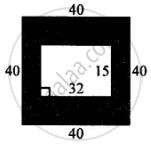
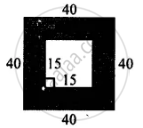
In the figure given below, find the area of shaded region: (All measurements are in cm)
The base of a parallelogram is thrice it height. If its area is 768 cm2, find the base and the height of the parallelogram.
Find the height of a triangle whose base is 18 cm and the area is 270 cm2.
Find the area of a right-angled triangle whose hypotenuse is 13 cm long and one of its legs is 12 cm long.
Find the area of an equilateral triangle whose each side is 16 cm. (Take `sqrt3`= 1.73)
The sides of a triangle are in the ratio 15 : 13 : 14 and its perimeter is 168 cm. Find the area of the triangle.
The length and breadth of a rectangular paper are 35 cm and 22 cm. Find the area of the largest circle which can be cut out of this paper.
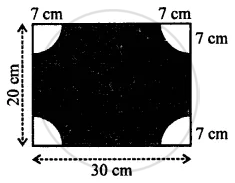
From each corner of a rectangular paper (30 cm x 20 cm) a quadrant of a circle of radius 7 cm is cut. Find the area of the remaining paper i.e., shaded portion.