Advertisements
Advertisements
प्रश्न
The adjacent sides of a parallelogram are 15 cm and 10 cm. If the distance between the longer sides is 6 cm, find the distance between the shorter sides.
Advertisements
उत्तर
In parallelogram ABCD
AB = DC = 15 cm
BC = AD = 10 cm
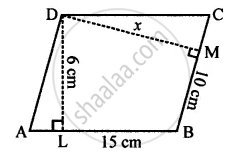
Distance between longer sides AB and DC is 6 cm
i.e., perpendicular DL = 6 cm
DM ⊥ BC
Area of parallelogram = Base × Altitude
= AB × DL = 15 × 6 = 90 cm2
Again let DM = x cm
∴ Area of parallelogram ABCD = BC × DM
= 10 × x = 10x cm2
∴ 10x cm2 = 90 cm2
⇒ x = `90/10` = 9 cm
APPEARS IN
संबंधित प्रश्न
In the figure given below, find the area of shaded region: (All measurements are in cm)
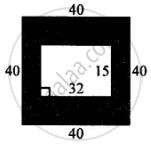
In the figure given below, find the area of shaded region: (All measurements are in cm)
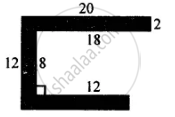
One side of a parallelogram is 20 cm and its distance from the opposite side is 16 cm. Find the area of the parallelogram.
Find the area of a triangle whose base is 30 cm and the height is 18 cm.
The sides of a triangle are 21 cm, 17 cm, and 10 cm. Find its area.
Find the base of a triangle whose area is 360 cm2 and height is 24 cm.
The area of an equilateral triangle is (`64xxsqrt3`) cm2. Find the length of each side of the triangle.
The sides of a triangle are in the ratio 15 : 13 : 14 and its perimeter is 168 cm. Find the area of the triangle.
The diameter of the wheel of a car is 70 cm. How many revolutions will it make to travel one kilometer?
The length and breadth of a rectangular paper are 35 cm and 22 cm. Find the area of the largest circle which can be cut out of this paper.
