Advertisements
Advertisements
प्रश्न
The sides of a triangle are 21 cm, 17 cm, and 10 cm. Find its area.
Advertisements
उत्तर
Let a = 21 cm, b = 17 cm and c = 10 cm
∴ a + b + c
= 21 cm + 17 cm + 10 cm = 48 cm
s =`"a + b + c"/2=48/2` = 24 cm
Area of the triangle
= `sqrt(s(s-a)(s-b)(s-c))`
= `sqrt(24(24-21)(24-17)(24-10))`
= `sqrt(24xx3xx7xx14)`
= `sqrt(2xx2xx2xx3xx3xx7xx2xx7)`
= 2 × 2 × 3 × 7
= 84 cm2
APPEARS IN
संबंधित प्रश्न
In the figure given below, find the area of shaded region: (All measurements are in cm)
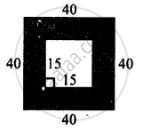
One side of a parallelogram is 20 cm and its distance from the opposite side is 16 cm. Find the area of the parallelogram.
Find the area of the rhombus, if its diagonals are 30 cm and 24 cm.
One side of a parallelogram is 18 cm and its area is 153 cm2. Find the distance of the given side from its opposite side.
The area of a right-angled triangle is 160 cm2. If its one leg is 16 cm long, find the length of the other leg.
Find the area of an isosceles triangle whose base is 16 cm and the length of each of the equal sides is 10 cm.
The legs of a right-angled triangle are in the ratio 4 : 3 and its area is 4056 cm2. Find the length of its legs.
The diameter of a circle is 20 cm. Taking π = 3.14, find the circumference and its area.
The diameter of every wheel of a car is 63 cm. How much distance will the car move during the 2000 revolutions of its wheel.
A metal wire, when bent in the form of a square of largest area, encloses an area of 484 cm2. Find the length of the wire. If the same wire is bent to the largest circle, find:
(i) radius of the circle formed.
(ii) area of the circle.
