Advertisements
Advertisements
प्रश्न
Find the area of an isosceles triangle whose base is 16 cm and the length of each of the equal sides is 10 cm.
Advertisements
उत्तर
In isosceles Δ ABC
Base BC = 16 cm
and AB = AC = 10 cm

Let AD ⊥ BC and BD = `1/2"BC"=16/2`
∴ BD = 8 cm
In right Δ ABD
AB2 = AD2 + BD2 ..............(Pythagoras Theorem)
(10)2 = AD2 + (8)2
100 = AD2 + 64
100 − 64 = AD2
36 = AD2
AD = `sqrt36=sqrt(6xx6)`
∴ AD = 6 cm
Now, the area of triangle =`("Base"xx"Altitude")/2`
= `(16xx6)/2` = 48 cm2
APPEARS IN
संबंधित प्रश्न
In the figure given below, find the area of shaded region: (All measurements are in cm)
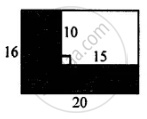
In the figure given below, find the area of shaded region: (All measurements are in cm)
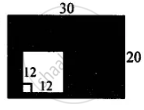
In the figure given below, find the area of shaded region: (All measurements are in cm)
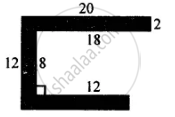
One side of a parallelogram is 20 cm and its distance from the opposite side is 16 cm. Find the area of the parallelogram.
Find the area of the rhombus, if its diagonals are 30 cm and 24 cm.
If the area of a rhombus is 112 cm2 and one of its diagonals is 14 cm, find its other diagonal.
The area of a rhombus is 84 cm2 and its perimeter is 56 cm. Find its height.
Find the area of a right-angled triangle whose hypotenuse is 13 cm long and one of its legs is 12 cm long.
Find the area of an equilateral triangle whose each side is 16 cm. (Take `sqrt3`= 1.73)
The sides of a triangle are 21 cm, 17 cm, and 10 cm. Find its area.
