Advertisements
Advertisements
Question
The rate constant for the decomposition of N2O5 at various temperatures is given below:
| T/°C | 0 | 20 | 40 | 60 | 80 |
| 105 × k/s−1 | 0.0787 | 1.70 | 25.7 | 178 | 2140 |
Draw a graph between ln k and `1/T` and calculate the values of A and Ea. Predict the rate constant at 30º and 50ºC.
Advertisements
Solution
The rate constants for the decomposition of N2O5 at different temperatures are shown below.
| T(°C) | T(K) | `1/T` | k(s−1) | ln k (= 2.303 log k) |
| 0 | 273 | 3.6 × 10⁻³ | 7.87 × 10⁻⁷ | −14.06 |
| 20 | 293 | 3.4 × 10⁻³ | 1.70 × 10⁻⁵ | −10.98 |
| 40 | 313 | 3.19 × 10⁻³ | 25.7 × 10⁻⁵ | −8.266 |
| 60 | 333 | 3.00 × 10⁻³ | 178 × 10−5 | −6.332 |
| 80 | 353 | 2.8 × 10⁻³ | 2140 × 10−5 | −3.844 |
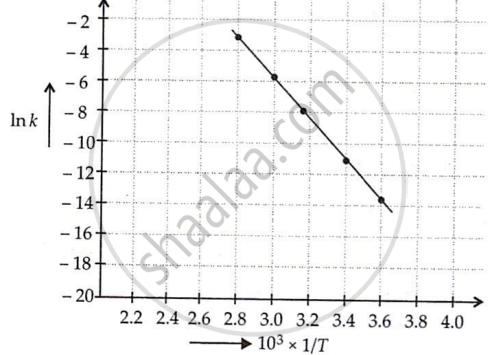
Slope of the line = tan θ
= `(y_2 - y_1)/(x_2 - x_1)`
= `(-10.98 - (-14.06))/(3.4 - 3.6) xx 10^3`
= `3.08/-0.2 xx 10^3`
= −15.4 × 10³
Ea = −slope × R
= −(−15.4 × 103 × 8.314)
= 128.035 kJ K−1 mol−1
Again,
ln A = `ln k + E_a/(RT)`
= `-14.06 + (128.035 xx 10^3)/(8.314 xx 273)`
= `-14.06 + 128035/2269.722`
= −14.06 + 56.40
ln A = 42.34
⇒ A = antilog 42.34
= 0.3388 × 10¹⁹
Values of the rate constant k at 303 K and 323 K can be obtained from the graph.
First, k is obtained corresponding to `1/(303 K) and 1/(323 K)`, and then k is calculated.
RELATED QUESTIONS
What will be the effect of temperature on rate constant?
The decomposition of A into product has value of k as 4.5 × 10³ s−1 at 10°C and energy of activation 60 kJ mol−1. At what temperature would k be 1.5 × 10⁴ s−1?
In the Arrhenius equation for a first order reaction, the values of ‘A’ of ‘Ea’ are 4 × 10¹³ sec−1 and 98.6 kJ mol−1 respectively. At what temperature will its half life period be 10 minutes?
[R = 8.314 J K−1 mol−1]
Define activation energy.
What is the effect of adding a catalyst on Activation energy (Ea)
A first-order reaction is 50% completed in 40 minutes at 300 K and in 20 minutes at 320 K. Calculate the activation energy of the reaction. (Given : log 2 = 0·3010, log 4 = 0·6021, R = 8·314 JK–1 mol–1)
The chemical reaction in which reactants require high amount of activation energy are generally ____________.
Mark the incorrect statements:
(i) Catalyst provides an alternative pathway to reaction mechanism.
(ii) Catalyst raises the activation energy.
(iii) Catalyst lowers the activation energy.
(iv) Catalyst alters enthalpy change of the reaction.
The reaction between \[\ce{H2(g)}\] and \[\ce{O2(g)}\] is highly feasible yet allowing the gases to stand at room temperature in the same vessel does not lead to the formation of water. Explain.
Why does the rate of a reaction increase with rise in temperature?
Oxygen is available in plenty in air yet fuels do not burn by themselves at room temperature. Explain.
Thermodynamic feasibility of the reaction alone cannot decide the rate of the reaction. Explain with the help of one example.
Why in the redox titration of \[\ce{KMnO4}\] vs oxalic acid, we heat oxalic acid solution before starting the titration?
What happens to most probable kinetic energy and the energy of activation with increase in temperature?
Total number of vibrational degrees of freedom present in CO2 molecule is
The activation energy in a chemical reaction is defined as ______.
The activation energy in a chemical reaction is defined as ______.
The activation energy of one of the reactions in a biochemical process is 532611 J mol–1. When the temperature falls from 310 K to 300 K, the change in rate constant observed is k300 = x × 10–3 k310. The value of x is ______.
[Given: ln 10 = 2.3, R = 8.3 J K–1 mol–1]
The rate of a reaction quadruples when temperature changes from 27°C to 57°C calculate the energy of activation.
(Given: R = 8. 314 J K−1 mol−1, log 4 = 0.6021)
