Advertisements
Advertisements
प्रश्न
The rate constant for the decomposition of N2O5 at various temperatures is given below:
| T/°C | 0 | 20 | 40 | 60 | 80 |
| 105 × k/s−1 | 0.0787 | 1.70 | 25.7 | 178 | 2140 |
Draw a graph between ln k and `1/T` and calculate the values of A and Ea. Predict the rate constant at 30º and 50ºC.
Advertisements
उत्तर
The rate constants for the decomposition of N2O5 at different temperatures are shown below.
| T(°C) | T(K) | `1/T` | k(s−1) | ln k (= 2.303 log k) |
| 0 | 273 | 3.6 × 10⁻³ | 7.87 × 10⁻⁷ | −14.06 |
| 20 | 293 | 3.4 × 10⁻³ | 1.70 × 10⁻⁵ | −10.98 |
| 40 | 313 | 3.19 × 10⁻³ | 25.7 × 10⁻⁵ | −8.266 |
| 60 | 333 | 3.00 × 10⁻³ | 178 × 10−5 | −6.332 |
| 80 | 353 | 2.8 × 10⁻³ | 2140 × 10−5 | −3.844 |
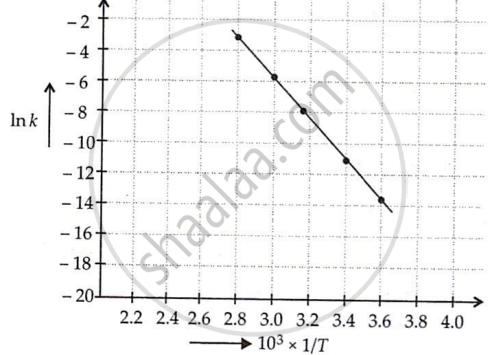
Slope of the line = tan θ
= `(y_2 - y_1)/(x_2 - x_1)`
= `(-10.98 - (-14.06))/(3.4 - 3.6) xx 10^3`
= `3.08/-0.2 xx 10^3`
= −15.4 × 10³
Ea = −slope × R
= −(−15.4 × 103 × 8.314)
= 128.035 kJ K−1 mol−1
Again,
ln A = `ln k + E_a/(RT)`
= `-14.06 + (128.035 xx 10^3)/(8.314 xx 273)`
= `-14.06 + 128035/2269.722`
= −14.06 + 56.40
ln A = 42.34
⇒ A = antilog 42.34
= 0.3388 × 10¹⁹
Values of the rate constant k at 303 K and 323 K can be obtained from the graph.
First, k is obtained corresponding to `1/(303 K) and 1/(323 K)`, and then k is calculated.
संबंधित प्रश्न
Consider the reaction
`3I_((aq))^-) +S_2O_8^(2-)->I_(3(aq))^-) + 2S_2O_4^(2-)`
At particular time t, `(d[SO_4^(2-)])/dt=2.2xx10^(-2)"M/s"`
What are the values of the following at the same time?
a. `-(d[I^-])/dt`
b. `-(d[S_2O_8^(2-)])/dt`
c. `-(d[I_3^-])/dt`
The rate constant for the first-order decomposition of H2O2 is given by the following equation:
`logk=14.2-(1.0xx10^4)/TK`
Calculate Ea for this reaction and rate constant k if its half-life period be 200 minutes.
(Given: R = 8.314 JK–1 mol–1)
The rate constant of a first order reaction increases from 2 × 10⁻² to 4 × 10⁻² when the temperature changes from 300 K to 310 K. Calculate the energy of activation (Ea).
(log 2 = 0.301, log 3 = 0.4771, log 4 = 0.6021)
The rate constant for the decomposition of hydrocarbons is 2.418 × 10⁻⁵ s−1 at 546 K. If the energy of activation is 179.9 kJ/mol, what will be the value of pre-exponential factor?
The decomposition of A into product has value of k as 4.5 × 10³ s−1 at 10°C and energy of activation 60 kJ mol−1. At what temperature would k be 1.5 × 10⁴ s−1?
A first-order reaction is 50% completed in 40 minutes at 300 K and in 20 minutes at 320 K. Calculate the activation energy of the reaction. (Given : log 2 = 0·3010, log 4 = 0·6021, R = 8·314 JK–1 mol–1)
The decomposition of a hydrocarbon has value of rate constant as 2.5×10⁴s-1 At 27° what temperature would rate constant be 7.5×104 × 3 s-1if energy of activation is 19.147 × 10³ J mol-1 ?
Write a condition under which a bimolecular reaction is kinetically first order. Give an example of such a reaction. (Given : log2 = 0.3010,log 3 = 0.4771, log5 = 0.6990).
The chemical reaction in which reactants require high amount of activation energy are generally ____________.
Activation energy of a chemical reaction can be determined by ______.
Consider figure and mark the correct option.
Which of the following statements are in accordance with the Arrhenius equation?
(i) Rate of a reaction increases with increase in temperature.
(ii) Rate of a reaction increases with decrease in activation energy.
(iii) Rate constant decreases exponentially with increase in temperature.
(iv) Rate of reaction decreases with decrease in activation energy.
Why does the rate of a reaction increase with rise in temperature?
Total number of vibrational degrees of freedom present in CO2 molecule is
The activation energy in a chemical reaction is defined as ______.
The slope of Arrhenius Plot `("In" "k" "v"//"s" 1/"T")` of first-order reaction is −5 × 10³ K. The value of Ea of the reaction is. Choose the correct option for your answer. [Given R = 8.314 JK−1mol−1]
It is generally observed that the rate of a chemical reaction becomes double with every 10°C rise in temperature. If the generalisation holds true for a reaction in the temperature range of 298 K to 308 K, what would be the value of activation energy (Ea) for the reaction?
Which plot of ln k vs `1/T` is consistent with the Arrhenius equation?
Given below are two statements:
Statement I: The nutrient deficient water bodies lead to eutrophication.
Statement II: Eutrophication leads to decrease in the level of oxygen in the water bodies.
In the light of the above statements, choose the correct answer from the options given below:
