Advertisements
Advertisements
प्रश्न
A first-order reaction is 50% complete in 30 minutes at 300 K and in 10 minutes at 320 K. Calculate activation energy (Ea) for the reaction. [R = 8.314 J K−1 mol−1]
[Given: log 2 = 0.3010, log 3 = 0.4771, log 4 = 0.6021]
A first order reaction is 50% completed in 30 minutes at 300 K and in 10 minutes at 320 K. Calculate the activation energy of the reaction. (R = 8.314 J K−1 mol−1)
Advertisements
उत्तर
Given: T1/2 = 30 min, T1 = 300 K
T1/2 = 10 min, T2 = 320 K
Formula: `log k_2/k_1 = E_a/(2.303 R) [1/T_1 - 1/T_2]`
k = `0.693/(t_(1//2))`
k1 at 300 K = `0.693/30` min−1
k2 at 320 K = `0.693/10` min−1
`log (k_2/k_1) = E_a/(2.303 R) [1/T_1 - 1/T_2]`
`log ((0.693/10)/(0.693/30)) = E_a/(2.303 R) [1/300 - 1/320]`
log (3) = `E_a/(2.303 R) [20/(300 xx 320)]`
0.4771 = `E_a/(2.303 xx 8.314) [20/(96000)]`
0.4771 = `E_a/(2.303 xx 8.314) [20/(96000)]`
Ea = `(0.4771 xx 2.303 xx 8.314 xx 96000)/20`
= `876969.73/20`
= 43848.48 J/mol
Ea = 43.8 kJ mol−1
Hence, the activation energy of the reaction is 43.8 kJ−1.
APPEARS IN
संबंधित प्रश्न
Consider the reaction
`3I_((aq))^-) +S_2O_8^(2-)->I_(3(aq))^-) + 2S_2O_4^(2-)`
At particular time t, `(d[SO_4^(2-)])/dt=2.2xx10^(-2)"M/s"`
What are the values of the following at the same time?
a. `-(d[I^-])/dt`
b. `-(d[S_2O_8^(2-)])/dt`
c. `-(d[I_3^-])/dt`
The rate constant of a first order reaction increases from 2 × 10⁻² to 4 × 10⁻² when the temperature changes from 300 K to 310 K. Calculate the energy of activation (Ea).
(log 2 = 0.301, log 3 = 0.4771, log 4 = 0.6021)
The rate of the chemical reaction doubles for an increase of 10 K in absolute temperature from 298 K. Calculate Ea.
In the Arrhenius equation for a first order reaction, the values of ‘A’ of ‘Ea’ are 4 × 10¹³ sec−1 and 98.6 kJ mol−1 respectively. At what temperature will its half life period be 10 minutes?
[R = 8.314 J K−1 mol−1]
Activation energy of a chemical reaction can be determined by ______.
Which of the following graphs represents exothermic reaction?
(a)

(b)
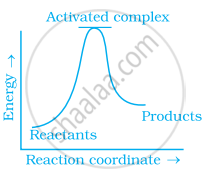
(c)
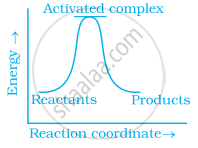
What happens to most probable kinetic energy and the energy of activation with increase in temperature?
Arrhenius equation can be represented graphically as follows:

The (i) intercept and (ii) slope of the graph are:
An exothermic reaction X → Y has an activation energy 30 kJ mol-1. If energy change ΔE during the reaction is - 20 kJ, then the activation energy for the reverse reaction in kJ is ______.
Which plot of ln k vs `1/T` is consistent with the Arrhenius equation?
