Advertisements
Advertisements
प्रश्न
Why does the rate of a reaction increase with rise in temperature?
Advertisements
उत्तर
At higher temperatures, larger fraction of colliding particles can cross the energy barrier (i.e. the activation energy), which leads to faster rate.
APPEARS IN
संबंधित प्रश्न
Explain a graphical method to determine activation energy of a reaction.
The rate constant of a first order reaction increases from 2 × 10⁻² to 4 × 10⁻² when the temperature changes from 300 K to 310 K. Calculate the energy of activation (Ea).
(log 2 = 0.301, log 3 = 0.4771, log 4 = 0.6021)
What will be the effect of temperature on rate constant?
The rate of the chemical reaction doubles for an increase of 10 K in absolute temperature from 298 K. Calculate Ea.
The decomposition of hydrocarbon follows the equation
k = `(4.5 xx 10^11 s^-1) e^(-28000 K//T)`
Calculate Ea.
The rate of a reaction quadruples when the temperature changes from 293 K to 313 K. Calculate the energy of activation of the reaction assuming that it does not change with temperature.
The rate constant of a first order reaction are 0.58 S-1 at 313 K and 0.045 S-1 at 293 K. What is the energy of activation for the reaction?
Define activation energy.
Calculate activation energy for a reaction of which rate constant becomes four times when temperature changes from 30 °C to 50 °C. (Given R = 8.314 JK−1 mol−1).
A first-order reaction is 50% completed in 40 minutes at 300 K and in 20 minutes at 320 K. Calculate the activation energy of the reaction. (Given : log 2 = 0·3010, log 4 = 0·6021, R = 8·314 JK–1 mol–1)
Write a condition under which a bimolecular reaction is kinetically first order. Give an example of such a reaction. (Given : log2 = 0.3010,log 3 = 0.4771, log5 = 0.6990).
The rate of chemical reaction becomes double for every 10° rise in temperature because of ____________.
Consider figure and mark the correct option.
Which of the following graphs represents exothermic reaction?
(a)

(b)
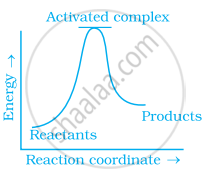
(c)
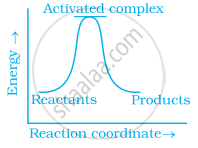
Mark the incorrect statements:
(i) Catalyst provides an alternative pathway to reaction mechanism.
(ii) Catalyst raises the activation energy.
(iii) Catalyst lowers the activation energy.
(iv) Catalyst alters enthalpy change of the reaction.
The slope of Arrhenius Plot `("In" "k" "v"//"s" 1/"T")` of first-order reaction is −5 × 10³ K. The value of Ea of the reaction is. Choose the correct option for your answer. [Given R = 8.314 JK−1mol−1]
Explain how and why will the rate of reaction for a given reaction be affected when the temperature at which the reaction was taking place is decreased.
Activation energy of any chemical reactions can be calculated if one knows the value of:
Assertion (A): A reaction can have zero activation energy.
Reason (R): The minimum extra amount of energy absorbed by reactant molecules so that their energy becomes equal to the threshold value is called activation energy.
In the light of the above statements, choose the correct answer from the options given below:
