Advertisements
Advertisements
प्रश्न
Predict the main product of the following reactions: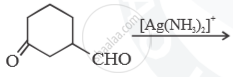
Advertisements
उत्तर
Predict main product of following reaction
Main product 3-oxocyclohexanecarboxylic acid
APPEARS IN
संबंधित प्रश्न
The rate constant of a first order reaction increases from 2 × 10⁻² to 4 × 10⁻² when the temperature changes from 300 K to 310 K. Calculate the energy of activation (Ea).
(log 2 = 0.301, log 3 = 0.4771, log 4 = 0.6021)
The rate constant for the decomposition of N2O5 at various temperatures is given below:
| T/°C | 0 | 20 | 40 | 60 | 80 |
| 105 × k/s−1 | 0.0787 | 1.70 | 25.7 | 178 | 2140 |
Draw a graph between ln k and `1/T` and calculate the values of A and Ea. Predict the rate constant at 30º and 50ºC.
Consider a certain reaction \[\ce{A -> Products}\] with k = 2.0 × 10⁻² s−1. Calculate the concentration of A remaining after 100 s if the initial concentration of A is 1.0 mol L−1.
What is the effect of adding a catalyst on Activation energy (Ea)
Write a condition under which a bimolecular reaction is kinetically first order. Give an example of such a reaction. (Given : log2 = 0.3010,log 3 = 0.4771, log5 = 0.6990).
The rate of chemical reaction becomes double for every 10° rise in temperature because of ____________.
During decomposition of an activated complex:
(i) energy is always released
(ii) energy is always absorbed
(iii) energy does not change
(iv) reactants may be formed
Arrhenius equation can be represented graphically as follows:

The (i) intercept and (ii) slope of the graph are:
The activation energy of one of the reactions in a biochemical process is 532611 J mol–1. When the temperature falls from 310 K to 300 K, the change in rate constant observed is k300 = x × 10–3 k310. The value of x is ______.
[Given: ln 10 = 2.3, R = 8.3 J K–1 mol–1]
The equation k = `(6.5 xx 10^12 "s"^(-1))"e"^(- 26000 " K"//"T")` is followed for the decomposition of compound A. The activation energy for the reaction is ______ kJ mol-1. (Nearest integer) (Given: R = 8.314 JK-1 mol-1)
