Advertisements
Advertisements
Question
The photoelectric cut-off voltage in a certain experiment is 1.5 V. What is the maximum kinetic energy of photoelectrons emitted?
Advertisements
Solution
Photoelectric cut-off voltage, V0 = 1.5 V
The maximum kinetic energy of the emitted photoelectrons is given as:
Ke = eV0
Where,
e = Charge on an electron = 1.6 × 10⁻¹⁹ C
∴ Ke = 1.6 × 10−19 × 1.5
= 2.4 × 10⁻¹⁹ J
Therefore, the maximum kinetic energy of the photoelectrons emitted in the given experiment is 2.4 × 10⁻¹⁹ J.
RELATED QUESTIONS
A hot body is placed in a closed room maintained at a lower temperature. Is the number of photons in the room increasing?
Should the energy of a photon be called its kinetic energy or its internal energy?
In an experiment on photoelectric effect, a photon is incident on an electron from one direction and the photoelectron is emitted almost in the opposite direction. Does this violate the principle of conservation of momentum?
It is found that yellow light does not eject photoelectrons from a metal. Is it advisable to try with orange light or with green light?
If an electron has a wavelength, does it also have a colour?
Let nr and nb be the number of photons emitted by a red bulb and a blue bulb, respectively, of equal power in a given time.
A totally reflecting, small plane mirror placed horizontally faces a parallel beam of light, as shown in the figure. The mass of the mirror is 20 g. Assume that there is no absorption in the lens and that 30% of the light emitted by the source goes through the lens. Find the power of the source needed to support the weight of the mirror.
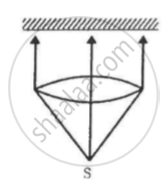
(Use h = 6.63 × 10⁻³⁴J-s = 4.14 × 10⁻¹⁵ eV-s, c = 3 × 10⁸ m/s and me = 9.1 × 10⁻³¹kg)
Show that it is not possible for a photon to be completely absorbed by a free electron.
Find the maximum magnitude of the linear momentum of a photoelectron emitted when a wavelength of 400 nm falls on a metal with work function 2.5 eV.
(Use h = 6.63 × 10⁻³⁴J-s = 4.14 × 10⁻¹⁵ eV-s, c = 3 × 10⁸ m/s and me = 9.1 × 10⁻³¹kg)
In an experiment on photoelectric effect, the stopping potential is measured for monochromatic light beams corresponding to different wavelengths. The data collected are as follows:-
Wavelength (nm): 350 400 450 500 550
Stopping potential (V): 1.45 1.00 0.66 0.38 0.16
Plot the stopping potential against inverse of wavelength (1/λ) on a graph paper and find (a) Planck's constant (b) the work function of the emitter and (c) the threshold wavelength.
(Use h = 6.63 × 10⁻³⁴J-s = 4.14 × 10⁻¹⁵ eV-s, c = 3 × 10⁸ m/s and me = 9.1 × 10⁻³¹kg)
Define the term: threshold frequency
In photoelectric effect, the photoelectric current started to flow. This means that the frequency of incident radiations is ______.
Consider a metal exposed to light of wavelength 600 nm. The maximum energy of the electron doubles when light of wavelength 400 nm is used. Find the work function in eV.
Two monochromatic beams A and B of equal intensity I, hit a screen. The number of photons hitting the screen by beam A is twice that by beam B. Then what inference can you make about their frequencies?
Consider a 20 W bulb emitting light of wavelength 5000 Å and shining on a metal surface kept at a distance 2 m. Assume that the metal surface has work function of 2 eV and that each atom on the metal surface can be treated as a circular disk of radius 1.5 Å.
- Estimate no. of photons emitted by the bulb per second. [Assume no other losses]
- Will there be photoelectric emission?
- How much time would be required by the atomic disk to receive energy equal to work function (2 eV)?
- How many photons would atomic disk receive within time duration calculated in (iii) above?
- Can you explain how photoelectric effect was observed instantaneously?
What is the effect of threshold frequency and stopping potential on increasing the frequency of the incident beam of light? Justify your answer.
Why is the polarity reversed during the procedure?
What happens if the frequency of incident radiation is below the threshold frequency?
When are photoelectrons emitted in relation to the threshold frequency?
