Advertisements
Advertisements
Question
The perimeter of an isosceles triangle is 32 cm. The ratio of the equal side to its base is 3 : 2. Find the area of the triangle.
Advertisements
Solution
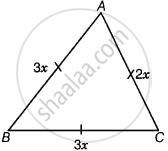
Let ABC be an isosceles triangle with perimeter 32 cm.
We have, ratio of equal side to its base is 3 : 2.
Let sides of triangle be AB = AC = 3x, BC = 2x
∵ Perimeter of a triangle = 32 m
Now, 3x + 3x + 2x = 32
`\implies` 8x = 32
`\implies` x = 4
∴ AB = AC = 3 × 4 = 12 cm
And BC = 2x = 2 × 4 = 8 cm
The sides of a triangle are a = 12 cm, b = 12 cm and c = 8 cm.
∴ Semi-perimeter of an isosceles triangle,
`s = (a + b + c)/2`
= `(12 + 12 + 8)/2`
= `32/2`
= 16 cm
∴ Area of an isosceles ΔABC
= `sqrt(s(s - a)(s - b)(s - c))` ...[By Heron’s formula]
= `sqrt(16(16 - 12)(16 - 12)(16 - 8))`
= `sqrt(16 xx 4 xx 4 xx 8)`
= `4 xx 4 xx 2sqrt(2) cm^2`
= `32sqrt(2) cm^2`
Hence, the area of an isosceles triangle is `32sqrt(2) cm^2`.
APPEARS IN
RELATED QUESTIONS
Find the area of a triangle two sides of which are 18 cm and 10 cm and the perimeter is 42 cm.
Sides of a triangle are in the ratio of 12 : 17 : 25 and its perimeter is 540 cm. Find its area.
Find the area of a quadrilateral ABCD in which AB = 42 cm, BC = 21 cm, CD = 29 cm, DA =34 cm and diagonal BD =20 cm.
Find the area of the triangle formed by the points
(1, – 1), (– 4, 6) and (– 3, – 5)
Determine whether the sets of points are collinear?
`(-1/2, 3), (-5, 6) and (-8, 8)`
Using Heron’s formula, find the area of a triangle whose sides are 10 cm, 24 cm, 26 cm
An isosceles right triangle has area 8 cm2. The length of its hypotenuse is ______.
The triangular side walls of a flyover have been used for advertisements. The sides of the walls are 13 m, 14 m and 15 m. The advertisements yield an earning of Rs 2000 per m2 a year. A company hired one of its walls for 6 months. How much rent did it pay?
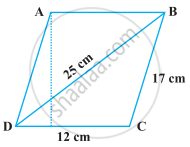
Find the area of a parallelogram given in figure. Also find the length of the altitude from vertex A on the side DC.
The sides of a quadrilateral ABCD are 6 cm, 8 cm, 12 cm and 14 cm (taken in order) respectively, and the angle between the first two sides is a right angle. Find its area.
