Advertisements
Advertisements
Question
From a point in the interior of an equilateral triangle, perpendiculars are drawn on the three sides. The lengths of the perpendiculars are 14 cm, 10 cm and 6 cm. Find the area of the triangle.
Advertisements
Solution
Let ABC be an equilateral triangle and O be the interior point and AQ, BR and CP are the perpendiculars drawn from point O such that OQ = 10 cm, OR = 6 cm, OP = 14 cm.
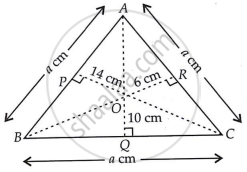
Let sides of an equilateral triangle be a cm.
Area of ΔOAB = `1/2 xx AB xx OP`
= `(1/2 xx a xx 14)cm^2`
= 7a cm2 ...(i)
Area of ΔOBC = `1/2 xx BC xx OQ`
= `(1/2 xx a xx 10)cm^2`
= 5a cm2 ...(ii)
Area of ΔOAC = `1/2 xx AC xx OR`
`(1/2 xx a xx 6)cm^2`
= 3a cm2 ...(iii)
∴ Area of ΔABC = Area of (ΔOAB + ΔOBC + ΔOAC)
= (7a + 5a + 3a) cm2
= 15a cm2 ...(iv) [From (i), (ii) and (iii)]
Area of an equilateral ΔABC = `sqrt(3)/4 a^2` ...(v)
From (iv) and (v),
`sqrt(3)/4 a^2 = 15a`
`\implies a = (60sqrt(3))/3 = 20sqrt(3)`
Substituting `a = 20sqrt(3)` in (v), we get
Area of ΔABC = `sqrt(3)/4 (20sqrt(3))^2`
= `300sqrt(3)`
Thus, the area of an equilateral triangle is `300sqrt(3) cm^2`.
APPEARS IN
RELATED QUESTIONS
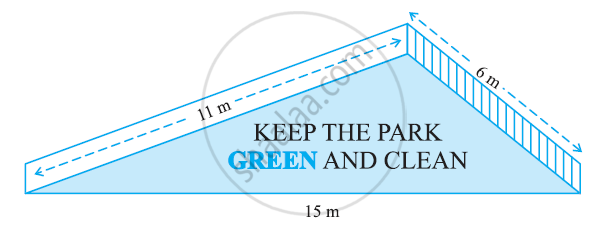
There is a slide in the park. One of its side walls has been painted in some colour with a message “KEEP THE PARK GREEN AND CLEAN” (see the given figure). If the sides of the wall are 15m, 11m, and 6m, find the area painted in colour.
A triangle has sides 35 cm, 54 cm and 61 cm long. Find its area. Also, find the smallest of its altitudes ?
Find the area of a triangle whose base and altitude are 5 cm and 4 cm respectively.
Sides of a triangle are cm 45 cm, 39 cm and 42 cm, find its area.
Determine whether the sets of points are collinear?
`(-1/2, 3), (-5, 6) and (-8, 8)`
A man walks near a wall, such that the distance between him and the wall is 10 units. Consider the wall to be the Y-axis. The path travelled by the man is
The area of a triangle is 5 sq. units. Two of its vertices are (2, 1) and (3, −2). The third vertex is (x, y) where y = x + 3. Find the coordinates of the third vertex.
Using Heron’s formula, find the area of a triangle whose sides are 1.8 m, 8 m, 8.2 m
Find the area of an equilateral triangle whose perimeter is 180 cm
If the side of a rhombus is 10 cm and one diagonal is 16 cm, the area of the rhombus is 96 cm2.
